Showing posts with label Pixar. Show all posts

Sunday, August 3, 2014

Pixar Story Secrets Revealed: The Twenty-Two Rules of Storytelling

John Lasseter famously described the three most important things about film-making as "One: story. Two: story. Three: story". Obviously, Pixar do a bunch of other stuff really well too, like, say character animation. But there is no doubt that great stories are at the heart of their work and their success. So what can we learn from Pixar about great story telling? Fortunately, Pixar are not guarded about their secrets. Recently, these "22 rules of storytelling" were tweeted by Pixar Story Artist Emma Coats.


Pixar's 22 Rules of Story Telling:
  1. You admire a character for trying more than for their successes.
  2. You gotta keep in mind what’s interesting to you as an audience, not what’s fun to do as a writer. They can be very different.
  3. Trying for theme is important, but you won’t see what the story is actually about til you’re at the end of it. Now rewrite it.
  4. Once upon a time there was ___. Every day, ___. One day ___. Because of that, ___. Because of that, ___. Until finally ___.
  5. Simplify. Focus. Combine characters. Hop over detours. You’ll feel like you’re losing valuable stuff but it sets you free.
  6. What is your character good at, comfortable with? Throw the polar opposite at them. Challenge them. How do they deal?
  7. Come up with your ending before you figure out your middle. Seriously. Endings are hard, get yours working up front.
  8. Finish your story, let go even if it’s not perfect. In an ideal world you have both, but move on. Do better next time.
  9. When you’re stuck, make a list of what WOULDN’T happen next. Lots of times the material to get you unstuck will show up.
  10. Pull apart the stories you like. What you like in them is a part of you; you’ve got to recognize it before you can use it.
  11. Putting it on paper lets you start fixing it. If it stays in your head, a perfect idea, you’ll never share it with anyone.
  12. Discount the 1st thing that comes to mind. And the 2nd, 3rd, 4th, 5th – get the obvious out of the way. Surprise yourself.
  13. Give your characters opinions. Passive/malleable might seem likable to you as you write, but it’s poison to the audience.
  14. Why must you tell THIS story? What’s the belief burning within you that your story feeds off of? That’s the heart of it.
  15. If you were your character, in this situation, how would you feel? Honesty lends credibility to unbelievable situations.
  16. What are the stakes? Give us reason to root for the character. What happens if they don’t succeed? Stack the odds against.
  17. No work is ever wasted. If it’s not working, let go and move on – it’ll come back around to be useful later.
  18. You have to know yourself: the difference between doing your best & fussing. Story is testing, not refining.
  19. Coincidences to get characters into trouble are great; coincidences to get them out of it are cheating.
  20. Exercise: take the building blocks of a movie you dislike. How d’you rearrange them into what you DO like?
  21. You gotta identify with your situation/characters, can’t just write ‘cool’. What would make YOU act that way?
  22. What’s the essence of your story? Most economical telling of it? If you know that, you can build out from there.
Where all Stories Begin
Here at Bucks we don't just teach the mechanics of animation and visual effects, we teach story as well. We recognise that all creative artists should be telling their own stories, creating their own characters and content, and finding their own creative voice. Getting a BA in Animation Visual Effects is not just about learn to press the right buttons, it's about becoming a well-rounded artist, and having something to say. 

---Alex 


For more about the experience of studying at Bucks New University, come and visit us at one of our Open Days,  take a virtual tour of one of our animation studios, check out what our students think of our course, and see why we're ranked in the top 12 creative universities in the UK. Find out why we're giving free laptops to all our students, and why we give all our students free access to videos at Lynda.com. Also, see what financial assistance might be available to you. Learn which is better for animation, a PC or a Mac? Get hold of a copy of a map so you can find your way around campus, and learn about motion capture at Bucks. And find out about how our online video tutorials work

Friday, July 18, 2014

Pixar's Pivotal Moment?

In my experience, the hardest thing to cultivate in a studio and the easiest thing to destroy is enthusiasm.  When the staff feels that the studio is dedicated to turning out good films and is providing the crew with opportunities to do their best work, the employees give extra effort.  When management says one thing while doing another, cynicism quickly sets in and every move or statement by management is viewed with suspicion.

The recent revelations that Ed Catmull was a willing conspirator to hold down wages and limit employment opportunities destroys his credibility as a manager.  While his contributions to the development of computer animation technology are untouched by this, his leadership credentials now lie in ruins.  While his book Creativity, Inc. has been praised by reviewers, my friend James Caswell says that it should be shelved in the fiction section.

Pixar has been very effective in keeping their internal workings from the public.  There aren't Pixar employees contributing to message boards or commenting on blogs.  Even those people with reason to complain, like Jan Pinkava and Brenda Chapman, have been circumspect.  Perhaps that's because the field is so small they didn't wish to burn bridges or perhaps there were settlements paid with silence as a condition.

But within Pixar, what's the mood?  Can any statement or policy from Catmull be treated as genuine now when the staff knows that he has been picking their pockets and limiting their prospects?  Has his authority been neutered?  Will Robert Iger ease him out as a way of reassuring the staff, or worse, leave him where he is and act as if nothing is wrong?

And what about John Lasseter?  What did he know and when did he know it?  Are there emails that implicate him as well?  Did he ever disagree with the policy or did he just accept it?  Regardless, he has profited from it.  Pixar's profits have increased the dividends and the price of Disney stock, making Lasseter richer.  Pixar's employees have paid for a portion of his winery.

Will this hasten people to leave the company?  Will it cause animation artists and students to think twice before applying to Pixar or the other studios involved in the conspiracy?  Will this push some employees or former employees to go public with their grievances?

As we don't know what's going on in Pixar, this may be a tipping point or the staff may just ignore it and keep working.  However, in the 1930s when the world was celebrating Walt Disney, conditions in his studio were deteriorating, eventually resulting in the strike that changed the company forever.

We may have to wait years until some Pixar employees retire or leave the field before we get a sense of how this was received within the company, but eventually the truth will come out.  The media love to build people up and then tear them down.  I'm guessing that it's just a matter of time before Pixar is in their sights.  Certainly the company has given them ample reason to take aim.

Tuesday, June 10, 2014

Pixar's Renderman - now free for students!


Pixar's Renderman, which is arguably the leading industry software for rendering high quality animation images, will soon be released free to students on a non-commercial basis. You can register now to get your free copy, available in August. Pixar's RenderMan is used throughout the CGI industry for the creation of stunning visual effects, and is highly recommended for student use.

Make beautiful images with Pixar software - free!
What is Renderman?
RenderMan is advanced technology for shading, lighting, and rendering. It is not an animation or modeling package, but is one of the industry's leading rendering packages.

Does Renderman work with Maya?
Yes. RenderMan can be plugged into one of the following tools: Maya, Houdini, Katana, or Cinema4D. If you use one of those packages you can try RenderMan. You can also use RenderMan if you have your own custom tool(s) for generating renderable 3D assets (RIB) for purposes such as scientific visualization. RenderMan by itself does not have a user interface or GUI.

When can we get hold of it?
Renderman is due to be released free for students and non-commercial use in August. You will have to register first and you will be notified when it is made available.

---Alex


Tuesday, April 29, 2014

Book Review: Creativity, Inc.

Most managers have holes in their knowledge.  Some people are promoted to management based on their skills.  They're the best at what they do in the company, so they are put in charge of other people.  The problem is that these managers have no training in how to handle people.  This is as true of assembly line managers as it is of college presidents.

Other people study management in school, but are ignorant of the processes they are managing.  They are in charge of people who know more than they do, though sometimes they won't admit it.  The world is full of MBAs who are incapable of producing any part of their company's product or service.

This is why there are so many books on business management.  The usual approach is to list things that should be done: Do this and you'll be successful.  Business books often differ in their recommendations, but the authors are convinced that their advice is sound.

Ed Catmull, one of the founders of Pixar and now President of Pixar and Disney Animation, takes a different approach in Creativity, Inc.  As he started out in computer science writing software, he is analytical about solving problems.  However, rather than declare the right way to do things, Catmull instead writes about things to beware of, including things that are unknowable.

Don't measure people by their current skills, but by how much they can grow.  Don't be afraid to hire people smarter than you are.  Understand the reasons behind a disagreement rather than focusing on the disagreement itself.  Try to find the causes of fear in an organization and root them out.  Don't believe you can prevent all errors by planning.   Don't punish failure or no one will try anything new.  Don't measure people by their mistakes, but by their ability to fix their mistakes.  Don't let the organizational structure prevent communication between departments and people.  Don't let one department's agenda override other agendas.  Don't confuse the process with the goal.

Catmull writes about the above using examples from his own career and from Pixar.  On the surface, it reads as if Pixar has managed to overcome problems common to large organizations and has found ways to encourage the staff to focus on the success of the company.   But while Catmull is not shy about Pixar's failures and close calls, I think that there's a gap between the Pixar of this book and the Pixar of reality.

For instance, Catmull talks about having to keep product moving through the pipeline in order to use the staff efficiently, but the need to "feed the beast" in his words often results in going with the tried and true rather than taking chances on new ideas.  As an example, he mentions The Lion King 1 1/2.  "This kind of thinking yields predictable, unoriginal fare because it prevents the kind of organic ferment that fuels true inspiration."  However, Pixar is as invested in sequels these days as any other animation studio.

At times, Catmull is disingenuous.  He implies that Pixar's influence was responsible for the crew of The Princess and the Frog taking a research trip to Louisiana, when in fact Disney had been making research trips for earlier films like The Lion King and The Hunchback of Notre Dame.  He gives credit to a Pixar developer for giving his crew time to pursue personal projects at work, while Google was widely reported to have been doing this for years.

Catmull praises Steve Jobs' design of Pixar's building, saying that it was constructed to force people from different departments to interact with each other.  Yet he also discusses a 2013 internal event called Notes Day, and one of the emails Catmull received after it was over said, "I met new people, got completely new points of view, and learned what other departments struggle with and succeed with."  Clearly, the geography of Pixar's building was not enough to fulfill Jobs' intention.

There is also a bit of a Pollyanna attitude.  While there are undoubtedly personal and legal reasons to avoid speaking about some staffing issues in specific terms, the pain and disruption of firings and layoffs is glossed over.  With one exception, the fate of the crew of Circle 7, the studio Disney created to do its own Pixar sequels, goes unmentioned.  There's nothing about the opening and closing of Pixar's Vancouver studio, either.

Catmull implies that directors are only replaced when stories are not progressing or when a director loses the confidence of the crew.  While no replaced directors are mentioned by name, it leaves a shadow over the heads of Jan Pinkava, Brenda Chapman and others who are criticized by implication, but without specifics and without the ability to refute the charges.

Catmull talks about personally delivering bonus cheques to each crew member on Tangled, talking about how important it was to acknowledge each person's contribution to the film.  And yet, after Frozen, now the most financially successful animated film in Disney history, those people laid off after completion have been denied bonus cheques though they contributed as much to the film as the people who were retained.  Disney will undoubtedly rehire some of these people in the future, and their commitment to future projects will be tempered by a knowing cynicism.  So much for team building.

There is much that is valuable in this book.  However, the contradictions in this book underline that no company is perfect and no matter how hard managers try to avoid or eliminate problems, there will always be some.  Catmull is to be praised for acknowledging this, but like everyone else, he's unaware of some of his own mistakes and blind spots.

Wednesday, March 12, 2014

Inside the Pixar Braintrust

"While problems in a film are fairly easy to identify, the sources of those problems are often extraordinarily difficult to assess. A mystifying plot twist or a less-than-credible change of heart in our main character is often caused by subtle, underlying issues elsewhere in the story. Think of it as a patient complaining of knee pain that stems from his fallen arches. If you operated on the knee, it wouldn't just fail to alleviate the pain, it could easily compound it. To alleviate the pain, you have to identify and deal with the root of the problem. The Braintrust's notes, then, are intended to bring the true causes of problems to the surface--not to demand a specific remedy. We don't want the Braintrust to solve a director's problem because we believe that, in all likelihood, our solution won't be as good as the one the director and his or her creative team comes up with."
Here is an excerpt from Ed Catmull's soon to be published book Creativity, Inc.

(Thanks, James Caswell)

Thursday, January 2, 2014

USD is a flexible FileFormat Plugin System From Pixar


Here is the USD Google Group mailing list:
"USD contains a flexible FileFormat plugin system that allows arbitrary file formats to be parsed, dynamically translated (if required), and composed into USD. USD will always ship with (at minimum) a complete, stable, ascii representation, as well as an efficient binary representation that may evolve over time. We have found the ascii representation to be tremendously valuable for debugging, and plan to also use it for archiving "legacy" assets such that current software will always be able to parse the assets without needing to maintain support for deprecated binary back-ends."

Friday, December 20, 2013

The Cinematography of "The Incredibles" Part 2

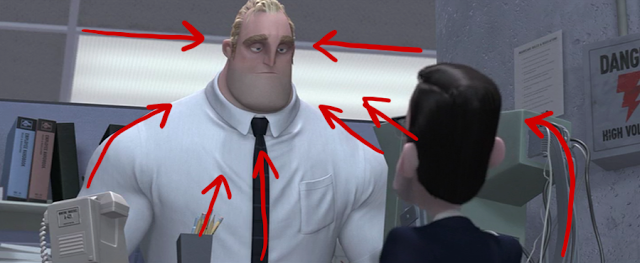
FloobyNooby has just posted another very detailed and extensive breakdown from Pixar's Incredibles continuing with the case study of the shot compositions from the film. It's a really great read!


Enjoy!
JP

Wednesday, December 11, 2013

Cinematography of "The Incredibles" - Part 1

WOW! FloobyNooby has just posted a very detailed and extensive breakdown from Pixar's Incredibles of  "...how the relationships of all the visual elements on screen were meticulously crafted to form a point focus in every shot." It's a really great read!


Enjoy!
JP

Tuesday, December 10, 2013

Saturday, October 26, 2013

ianimate Student Spotlight - Chris McCormick


Chris McCormick was one of my very first students at iAnimate in the Summer of 2011.  

He took my WS4 - Facial and Dialog Acting Class.  Chris did two great pieces with me in that class that I still show as examples of great acting and dialog.  (Clips are on the reel above)
1 - The Wrestler Clip and
2 - The Saving Silverman clip.

I remember being so proud of the work on The Wrestler clip because the character is trying to avoid any and all contact.  Every moment he does have eye contact with the person he is speaking to, becomes even more important this way.  Also, with the Saving Silverman clip where he repeat "Come on" over and over again, it is a challenge to say the same thing over and over in different ways and I think Chris nailed it.

Chris just finished his internship at Pixar and on his exit interview they told him the piece he worked on with me at iAnimate with Mickey Rourke from The Wrestler is what got him the internship.  Yay!  Chris is looking for work again, so check his demo reel out!

Wednesday, October 9, 2013

Pixar Canada and Money

I don't for a minute buy the official reason for shutting Pixar Canada down.  No other part of the Disney empire is concerned about having everything under one roof.  Certainly, Disney TV animation had no problem having Planes produced overseas, and if Pixar was having problems with the Vancouver facility, there are people within Disney who could easily troubleshoot any problems.

There are several potential reasons why the facility is shutting down, and they all relate to money.  As Disney is a public company, it reports its earnings quarterly.  It always makes a profit, the only question is how much?  If there are money losers for a quarter, the only way to compensate for that is to be making profits elsewhere in the company or to cut costs.

It's possible that the failure of The Lone Ranger, forcing Disney to write off up to $190 million,  may be one of the things motivating Pixar Canada's closure.  That money has to be made up somewhere, and closing a studio will certainly cut costs.

Another possibility is the delay of The Good Dinosaur.  Having replaced the director, the film is now delayed from it's original release date.  That means that Pixar's revenues will be less than expected due to the delay.  Again, a way to compensate for that is to cut costs.

Variety claims that that British Columbia's tax credits are not as lucrative as those offered by Ontario and Quebec.  While British Columbia may no longer seem lucrative enough to warrant Disney's presence, their tax credits have not changed so far as I know.  Whatever discount Disney was receiving before is still in place, so I doubt that tax credits were a big part of the decision.

Finally, there is the difficulty of putting a revenue figure on the short films that Pixar's Canadian studio made.  If a short is in front of a feature, how much of the box office can be attributed to the presence of the short?  If a short is an extra on a Blu-ray, how many more units are sold due to the inclusion of the short?  When the short shows up on TV, what part of the ratings can be credited to the short?  What percentage of sales of Toy Story merchandise can be attributed directly to the existence of the shorts?

When costs can be figured precisely but revenue cannot,  the costs carry more weight on a balance sheet. 

Note that none of the above reasons have anything to do with the work produced by the studio or the competence of the staff.  That's the tragedy of it.  A bean counter, charged with projecting profits for the quarter, decided that closing the studio was a good way to goose the numbers.  The layoffs are just collateral damage.  Robert Iger's job is to maintain the profits and the stock price.  Animation is just a means to that end and not necessarily the best one either.  A hundred artists are a tiny percentage of the tens of thousands of people who work for Disney, and their livelihoods pale beside the needs of shareholders and executives. 

Disney marches on.  Just don't get in the way.

Tuesday, October 8, 2013

Pixar Canada Shuts Down

Adios, Amigos


The Province is reporting that Pixar Canada has shut its doors and laid off its staff.
 Close to 100 employees at Pixar Canada’s Gastown animation studio lost their jobs Tuesday as the company decided to pack up the three-year-old operation and concentrate its operations in Emeryville, California.

 “A decision was made to refocus operations and resources under the one roof,” Barb Matheson, a spokesman for Pixar parent company Disney, said from Toronto. “Staff were just told today. Not great news, obviously. It was just a refocussing of efforts and resources to the one facility.”
The facility opened in the Spring of 2010.  This is the third studio that Disney has opened and closed in Canada and the second in Vancouver.  As recently as August 20, Pixar Canada was advertising for a layout artist and animators, so it appears that this decision was fairly sudden.

 It is important for animation artists and students to realize that while companies like Disney/Pixar appeal to a person's love for their characters and the status of joining a winning team, that branch plants are nothing more than economic calculations.  At the time it opened, Pixar Vancouver made economic sense; now, for some reason, it doesn't.  The Pixar dust that was liberally spread throughout Canada was a marketing opportunity to gain the company good will and bait for prospective employees.

It wouldn't surprise me if in five or ten years Disney/Pixar opens yet another studio in Canada.  I hope that people wake up to the fact that a job in a branch plant is just a job.  It might be a good job in terms of pay or opportunity, but in fundamental ways, it is no different than any other kind of job.  If they no longer want you, you're gone.

(If anyone from Pixar Canada would care to comment, I'd be interested in an employee's view of the shut down.  Did employees receive notice or severance?  What happens to projects that are still in progress?)

Thursday, October 3, 2013

TRIVIA THURSDAY: Wicked Kid


TRIVIA THURSDAY: The voice of the boy perched on his tricycle in Mr. Incredible’s driveway was voiced by Brad Bird’s son.

Monday, September 30, 2013

The Good Dinosaur is pushed

new-release-dates-good-dinosaur-finding-dory-maleficent
Bad news, everyone! As the LA Times confirms, Pixar has pushed back the release date for The Good Dinosaur to November 25th, 2015. The movie had its director replaced not too long ago. Currently, The good Dinosaur ix helmed by Pixar studio heads and former directors John Lasseter, Lee Unkrich and Mark Andrews and the film’s original co-director Peter Sohn.
This new release date was the original date of the Finding Nemo sequel, Finding DoryHowever, Finding Dory will now also be pushed back to the Summer of 2016. We don’t know if this means there won’t be a Pixar film in 2014, but as Ed Catmull says in the article: “Nobody ever remembers the fact that you slipped a film, but they will remember a bad film. Our conclusion was that we were going to give the [dinosaur] film some more time.”…If we have to wait, we’ll wait. 

Sunday, September 8, 2013

Bob Peterson is Off 'The Good Dinosaur'

Bob Peterson is Off 'The Good Dinosaur'; Various Pixar Directors Helming Film
Earlier this week, we reported on a very worrying rumor that longtime Pixarian Bob Peterson has been removed as director of The Good Dinosaur. Today, Pixar spoke out and confirmed the truth: Bob Peterson has been pulled off the project and replaced by a makeshift team of directors.

Ed Catmull confirmed the news to the LA Times, going on to explain the rationale behind the decision. "All directors get really deep in their films. Sometimes you just need a different perspective to get the idea out. Sometimes directors … are so deeply embedded in their ideas it actually takes someone else to finish it up. I would go so far as to argue that a lot of live-action films would be better off with that same process."

With no replacement for Peterson and a release date quickly approaching, various members of Pixar’s Brain Trust are working with original co-director Pete Sohn to continue work on The Good Dinosaur; John Lasseter, Lee Unkrich, and Mark Andrews are now overseeing various segments of the film. Denise Ream is producing in place of John Walker.

While directorial changes are nothing new for Pixar, having four directors juggle a project nine months before release doesn’t inspire much confidence. Pixar remains committed to the May 30 release date, but personally, I’d rather see them push the release back if it means a more polished result.

The good news: Peterson is still at the studio, set to direct another film.

Tuesday, August 27, 2013

John Lasseter explains what students need to learn to get a job at Pixar

In this excellent video interview,  Disney Studio Supremo and Pixar founder John Lasseter talks about the importance of mastering the basics language of film, art and design. Here at Bucks we could not agree more. Our course covers all the areas that John talks about here, including drawing, design, the language of film, in short - the basics.
Technology is important but so are the traditional elements of art and design. Life drawing? Of course. basic design principles? Definitely. We want our students to have a well-rounded training so that they can flourish as digital artists with a solid grounding in all the elements of film-making.

---Alex