Showing posts with label Walt Disney. Show all posts

Monday, September 29, 2014

It All Started With a Mouse - The History of Disney Animation

It All Started With a Mouse
Below is an excellent documentary on the History of Disney Animation, titled It All Started With a Mouse.  It was broadcast in 1989 - so it does not include anything from the digital era - but much of what the Disney Studio achieved is timeless, and still withstands close scrutiny today. In short, this is an excellent documentary on the history hand-drawn animation at the studio up until the late 1980s.  The video is hosted at YouTube (for some reason I can't embed the video here) but if you follow this link you'll find it OK. It runs an hour and a half, and is an excellent introduction to the medium of animation.

---Alex


Wednesday, July 23, 2014

The Illusion of Life - the Original Animation Bible

The original animation bible
The Illusion of Life was first published in the 1970s. It caused a sensation among animators, because it represented for the first time in print the accumulated wisdom of the Disney studio - set out in detail for anyone who cared to learn. The 1970s were a lean time for animation; Walt Disney was dead and the revival that would come with Who Framed Roger Rabbit? and The Little Mermaid was still far in the future.

The Illusion of Life was written by Frank Thomas and Ollie Johnstone, two of Disney's so-called "Nine Old Men", two of his top animators who had been with him since the early days and whose work had much to do with the development of the Disney style. Between them they created some of the most memorable moments in Disney animation.
Frank Thomas (centre) and Ollie Johnstone (Right)

The last film they worked on was The Fox and The Hound, not by any means a great film, but better than the next one that Disney would release - The Black Cauldron. By the 1970s Frank and Ollie were doing less animation, and focusing more on their book. The idea was to create a "bible" for future generations of animators, an authoritative reference work that make sure that the craft of animation developed under Walt Disney's benign leadership would not disappear. At the same time, they would tell the story of the Disney Studio.


The book is really two books in one. Around 10% of it is a manual of methods, a how-to guide for the aspiring animator and film-maker. The rest is the story of the Disney Studio - and a compelling story it is too. So good in fact, that it easily distracts the student from their purpose - to learn the nuts and bolts of animation.


Years ago, I took my copy of the book to a Xerox machine and copied all the bits that were relevant to the study of animation, so that I would not get distracted by the rest. It worked, but the original book is still a much more beautiful thing to take down from the shelf and enjoy.

Like The Animator's Survival Kit, The Illusion of Life is a book that should be on every animator's shelf.

---Alex

To find out about what it's like to study with us at Bucks New University, come and visit us at one of our Open Days,  take a virtual tour of one of our animation studios, check out what our students think of our course, and see why we're ranked in the top 12 creative universities in the UK. Find out why we're giving free laptops to all our students, and why we give all our students free access to videos at Lynda.com. Also, see what financial assistance might be available to you. Learn which is better for animation, a PC or a Mac? Get hold of a copy of a map so you can find your way around campus, and learn about motion capture at Bucks. And find out about how our online video tutorials work.


Friday, June 6, 2014

Art Babbitt, Gunther Lessing, and the Disney Strike

Jake Friedman is working on an authorized biography of animator Art Babbitt.  He also has a blog where he has been publishing various Babbitt-related documents and footage.  His latest entry is below, chronicling the relationship between Babbitt and Gunther Lessing, attorney for the Disney studio.  I wish that it had been uploaded at a higher resolution, so that the documents on screen would be clearer.

The Disney strike is one of those seismic events that continued to be influential long after it was over.  It caused people to leave Disney, others to be fired, and many of those people moved to other studios, spreading the knowledge they gained at Disney.  It also created animosities that continued for decades.

If the Disney studio had negotiated a contract with the Federation of Screen Cartoonists and blocked the entry of IATSE, would the strike have occurred?  The history of the Disney studio and unionism in animation might have been significantly different, but the opportunity was missed.

Tuesday, August 27, 2013

John Lasseter explains what students need to learn to get a job at Pixar

In this excellent video interview,  Disney Studio Supremo and Pixar founder John Lasseter talks about the importance of mastering the basics language of film, art and design. Here at Bucks we could not agree more. Our course covers all the areas that John talks about here, including drawing, design, the language of film, in short - the basics.
Technology is important but so are the traditional elements of art and design. Life drawing? Of course. basic design principles? Definitely. We want our students to have a well-rounded training so that they can flourish as digital artists with a solid grounding in all the elements of film-making.

---Alex

Friday, December 7, 2012

The Difference Between Walt Disney and Robert Iger

From Seth Godin:
"Capitalists take risks. They see an opportunity, an unmet need, and then they bring resources to bear to solve the problem and make a profit.

"Industrialists seek stability instead.

"Industrialists work to take working systems and polish them, insulate them from risk, maximize productivity and extract the maximum amount of profit. Much of society's wealth is due to the relentless march of productivity created by single-minded industrialists, particularly those that turned nascent industries (as Henry Ford did with cars) into efficient engines of profit.
"Industrialists don't mind government regulations if they write them, don't particularly like competition or creativity or change. They are maximizers of the existing status quo."

Sunday, May 20, 2012

Walt Disney and Spencer Tracy


I’ve long been aware that Walt Disney knew Spencer Tracy.  There’s a 1938 photo of them together with Tracy in polo togs and I knew that Disney also played polo.  Having read the excellent Spencer Tracy: ABiography by James Curtis, I learned that the relationship was longer and deeper than I knew.

While the Tracys and Disneys knew each other from polo, the Tracys also entertained the Disneys at their home.

Perhaps the greatest link was John Tracy, Spencer and Louise Tracy’s son, who was born deaf.  John had an interest in art and as a child started a newspaper.  The first issue sported a Mickey Mouse cover with an inscription by Disney which read, “Good Luck to Johnny Tracy.”

Louise Tracy spent a great deal of her life establishing the John Tracy Clinic for families with deaf children.  Having struggled to understand the best way to educate her son, she wanted to provide the best medical advice to other parents in the same situation.  Disney donated $100 at the clinic’s inception and was a member of the original board of directors.  When Disney toured the facility in 1043 and saw that the children were napping on mats on the floor, he donated cots and at Christmas sent over “a truck load of gifts – puppets and toys, all Disney-licensed, that could be used in teaching.”

Disney later funded a $12,000 short film, Listening Eyes, made by the clinic to explain its procedures and supplied the director, Larry Lansburgh, from his studio.

When the Disneys sailed on the Queen Elizabeth to Europe in July of 1952, Spencer Tracy was also on board and they socialized during the trip.

In 1957, Disney hired John Tracy, who by then had attended Choinard, to work at the studio.  He eventually was in charge of the cel library.  John left Disney when his sight deteriorated and he was no longer able to do the job.

In 1961, Disney was on the ticket sales committee for a fundraiser for the John Tracy Clinic and in 1967 after Walt’s and Spencer’s respective deaths, the Disney Foundation donated $100,000 to the John Tracy Clinic.

Friday, October 7, 2011

Steve Jobs as Walt Disney

Left to right: Ed Catmull, Steve Jobs, John Lasseter. Image lifted from the Pixar website.

It's been a few days since Steve Jobs passed away and I've had some time to gather my thoughts. It occurs to me that Jobs was like Walt Disney in that they shared traits common to visionary entrepreneurs.

Walt Disney didn't create animation. He wasn't responsible for every advance that came from his studio. And while there were others in animation who broke ground, the public identified the animation medium with Walt Disney. Disney went through a bankruptcy and several setbacks (the loss of Oswald the Rabbit and the defection of staff), but still managed to overcome the problems and continue to pursue his goals.

Steve Jobs didn't create personal computers. He wasn't responsible for every advance that came from Apple. Certainly there are others who broke ground in computing, but Jobs was the very public face of computers as lifestyle enhancers. Jobs was tossed out of the company he co-founded with Steve Wozniak, but during that period, he bought Pixar from George Lucas and created a second success before returning to Apple, where his second stint may have been more influential than his first.

I don't doubt that somebody would have made a cgi feature had Pixar not existed, but as we can see from films like Beowulf, cgi films might have been extensions of the visual effects world more than the animation world. As there have been animated films in every medium that were duds, who knows if that first cgi feature would have had the impact on audiences and on the marketplace if the film hadn't been Toy Story?

Pixar was not a sure thing. There were many technical problems to be solved and it was uncertain how an audience would react to an hour and a half of computer graphics. Jobs supported Catmull and Lasseter's goals, resulting in one of the most successful animation companies in history. Jobs' importance to animation history is secure for that alone.

So Jobs, like Disney, pursued his goals though they were risky. They both overcame setbacks to innovate in several fields. They both enhanced the lives of their audiences and were feted for it. That last item is a key point. Business schools may one day examine the careers of Michael Eisner or Robert Iger and take lessons from them, but the public won't. Jobs, like Disney, worked on a public stage, combining vision with showmanship. There are many successful business people, but few have the vision of these two men and fewer still have a vision that the public willingly embraces.

Animation is lucky to have crossed paths with both men.

(One of the best summations of Jobs' career I've read is an obituary written by animation fan and technology writer Harry McCracken for Time magazine.)

Thursday, August 4, 2011

Jonathan Rosenbaum on Walt Disney and Tex Avery

In early 1975, Film Comment magazine devoted an entire, oversize issue to Hollywood cartoons. It's well worth finding in a library or through an online service, as it contains a comprehensive interview with Chuck Jones as well as an interview with Grim Natwick and articles by Greg Ford and Mark Langer.


One piece was an essay on Walt Disney by film critic Jonathan Rosenbaum. Rosenbaum has now posted the first part of that essay on his website with the second part to follow shortly. As Thad has pointed out in the comments, part 2 is now up.


And here is Rosenbaum on Tex Avery.

Sunday, February 27, 2011

False Comparisons

Michael Barrier was interviewed in the Huffington Post for an article entitled "Animated Man: Cartoon Expert Michael Barrier Decries Pixar, Computers." This article already has multiple comments about Barrier's views and the article was linked to on Cartoon Brew, where there are yet more comments.

Two quotes caught my eye.
"What I'd call the direct connection between the animator and the character that you have when the animator is drawing the character with a pencil on a sheet of paper, it simply doesn't have an equivalent as far as I'm aware, or if it has an equivalent, it's much harder to establish."
I've already attempted to debunk this based on the techniques of both drawn and computer animation. My opinion hasn't changed. It's not the technique, it's how the production is organized. Should a cgi feature want a strong connection between animator and character, there is no technical reason why it couldn't be accomplished.

There are other reasons, salaries being one, that are incentives to prevent it. The more animators remain anonymous and the less distinctive their work, the harder it will be for an animator to demand a higher wage. As it is unlikely that an animator's name will ever increase the box office gross the same way a star voice does, why create star animators who will only drive up the budget?

The other quote is this one:
"If you look back, we've had computer animated features for 16 years going back to 'Toy Story,' and we've had computer animated characters before that, I have not seen the kind of evolution of those characters anything like the extremely compressed and dramatic evolution of the hand drawn characters in the 30s. When you think about how Disney went from 'Steamboat Willie' in 1928 to 'Snow White' less than ten years later, I think that's an extremely compressed [growth] that I don't think computer animation has nearly approached. What you have instead in computer animation is a continuing elaboration on texture and surfaces and three dimensional space without anything comparable for characters."
I am at a loss to understand why the development of one medium is being measured against the development of another. It assumes that both media exist in a vacuum, not part of larger forces such as the Hollywood industrial model of the time, the availability of media to the public, the prevailing popular culture and the world economy. The conditions that existed when Walt Disney grew from Steamboat Willie to Snow White and the Seven Dwarfs are wholly different than those that exist today.

Let's examine what Walt Disney actually did. If you look at the Oswald cartoons, made immediately before Steamboat Willie, you see films that are ten or more years behind the times compared to live action films. The films are shorts instead of features and at the level of story, characterization and acting, they are not as accomplished as Chaplin's The Immigrant of 1917. Compare the Oswalds to the best live action of the time (The Big Parade, The General, The Gold Rush, Sunrise, Seventh Heaven, The Crowd, Underworld, etc.) and you see a medium that cannot compete as an equal. Except for its use of sound, Steamboat Willie was no better.

What Disney was able to do in ten years was bring animation up to the level of live action films. Snow White and the films that followed were taken as seriously by film professionals, critics and audiences as the live action films of the time.

While computer animation struggled mightily against its technical limitations in the '80s and '90s (and I know because I was there), the advances made by Disney were taken for granted. The techniques developed at the studio were codified to the point where they could be taught in a classroom to 18 year olds at Cal Arts, including John Lasseter, and put between book covers by Frank Thomas and Ollie Johnston. Computer animation's problem wasn't knowing what was needed, which was often the case in the '30s, it was figuring out how to make characters flexible enough via software. Which is to say that computer animation didn't start as crudely as Disney animation did and had less far to go to get up to the level of live action films.

And the state of live action films is a key point. Disney did not exceed the expectations of what a live action film was supposed to be in his time and computer animation is not exceeding it today. I can make an economic and cultural argument that computer animation is more successful than Walt Disney ever was in that cgi films have been nominated for Best Picture, are more numerous and have been more profitable on a consistent basis than the features Disney made himself.

You can't criticize computer animation without looking at the bigger picture. This article in GQ, entitled "The Day the Movies Died," is subtitled "No, Hollywood films aren't going to get better anytime soon." Computer animated films exist in the same economic structure and cultural zeitgeist as live action films and aren't going to escape the problems that plague the larger industry.

I'm not defending the current state of computer animated features. I just saw a preview of Rango, directed by Gore Verbinski, and while the people at ILM have done a great job on the technical side, the film itself is thoroughly mediocre. It's emotional tone is all over the map; sometimes it's a parody and sometimes it wants to be taken seriously. Its references to other films only reminded me that it's inferior to the films it's quoting. And it is a perfect example of Barrier's observation that "computer animation is a continuing elaboration on texture and surfaces and three dimensional space without anything comparable for characters."

But I insist that it's not the medium. It's the structure of Hollywood and its economic model and it's what the public expects from movies. If computer animation sucks (and it often does), there are many more reasons than technology that are the cause. Furthermore, I don't think comparing it to Disney in the '30s is a valid or useful comparison.

Sunday, December 12, 2010

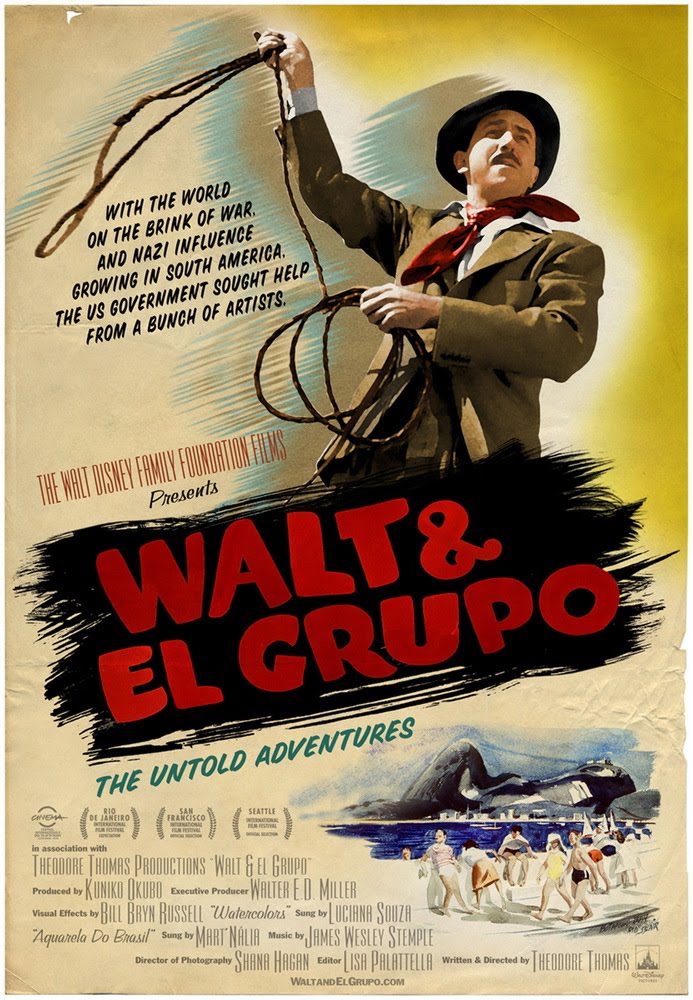
Walt & El Grupo

This is an excellent documentary chronicling the three month tour of South America by Walt Disney and assorted artists at the request of the U.S. State Department. With World War II already underway in Europe in 1941, the State Department was concerned that South America might align itself with the Axis powers, giving the Axis military bases on this side of the Atlantic Ocean. Their response, when the U.S. was still officially a neutral country, was to send cultural celebrities such as Disney (and, separately, Orson Welles) to South America to promote ties between North and South America.

This documentary, now on DVD, is written and directed by Ted Thomas, the son of Disney animator Frank Thomas who was one of the artists on the trip. Other participants included Lee and Mary Blair, Jim Bodrero, Herb Ryman, Ted Sears and Norm Ferguson. As all of the participants have passed away, the documentary relies on the memories of spouses, children and grandchildren who have often saved letters from the trip and read from them. Animation historians John Canemaker and J.B. Kaufman add their perspectives.

I have to say that I prefer this documentary to Waking Sleeping Beauty. The time period of Walt & El Grupo was a complex one, affected by both world and studio politics. In addition to the threat of war, the trip coincided with the famous strike at Disney and one incentive for Disney's participation was to get away from the studio so that less emotionally involved parties might work out a settlement. Beyond politics, the film is also good at focusing on the artists. We learn of their backgrounds and their contributions to the expedition while seeing examples of the art created during the trip. In this regard, the film is better balanced than Waking Sleeping Beauty.

Ted Thomas traveled to the places visited by the group, interviewing surviving participants or their descendants, showing newspaper clippings and movie footage of the time. The trip was well documented, both by the participants and by the local media, so Thomas has a wealth of material to work with.

The documentary does reveal that certain live action scenes of the trip used in Saludos Amigos were taken back in Burbank when the editors needed bridging material. (And if my eye doesn't deceive me, they were shot in 35mm where the actual footage was shot in 16mm.) The original release of Saludos Amigos is included as an extra. It's "original" in that it includes footage of Goofy smoking cigarettes, something deleted from later releases in order to protect children.

The film has a very large cast and if I have any criticism it's that I wish people were repeatedly identified. Seeing so many adult children of the group, it is easy to forget who they are relatives of. I also wish that more of the artwork produced on the trip was identified by artist where possible.

Walt & El Grupo does a good job of capturing a time and place in both world and Disney history. It's a pleasure to spend time with the artists and to see the magnitude of Walt Disney's popularity at the time.

Thursday, March 25, 2010

Miscellaneous Links

Kris Graft of Gamasutra writes that Warner Bros. Interactive Entertainment will be opening a gaming studio in Montreal that will gradually grow t0 300 employees by 2015.

Bhob Stewart writes about The Mickey Mouse Theater of the Air, a 1938 radio series which initially featured Walt Disney himself as host and the voice of Mickey Mouse. Stewart provides a player for seven episodes of the series.

Fantagraphics will soon publish the fourth volume of Our Gang comics by Walt Kelly. A complete 14 page story from the book in PDF format can be found here.

Farhad Manjoo of Slate reviews Rework by Jason Fried and David Heinemeier, about creating an online business with minimal start-up costs. You can read excerpts from the book here.

(Gamasutra link via James Caswell.)

Thursday, March 18, 2010

Rare Mickey

Last June, I posted about Michael Sragow's biography, Victor Fleming: American Movie Master. One of the films that Fleming directed was Around the World in 80 Minutes (1931), a documentary starring Douglas Fairbanks. The reason for my post was that the film contained original Disney animation of Mickey Mouse. I was not aware of this and a quick scan of the animation history books on my shelf didn't lead to any information.

Over at Didier Ghez's Disney History site, JB Kaufman was able to provide some information, as he had screened the film at the Library of Congress.

I recently learned that the film is now on DVD from Grapevine Video. I purchased a copy, and below you'll see some extremely rare Mickey animation. I have no idea who animated it, though I might guess Dick Lundy. Enjoy.