Showing posts with label books. Show all posts

Sunday, September 21, 2014

Book Review: The Webcomics Handbook

While comics are not animation, there is a great deal of overlap, both in terms of artists as well as how artists are marketing their work these days.  In this way, animation artists who are interested in using the web as a revenue source, or are interested in self publishing or exhibiting at conventions can find a wealth of advice from Brad Guigar's The Webcomics Handbook.

Guigar has been doing webcomics since 2000 and is the founder of Webcomics.com, an online site dedicated to sharing knowledge with artists who are marketing and selling their work online.  He is the co-author of How to Make Webcomics, a book I plugged earlier.

The value of Guigar's latest book is how incredibly specific it is.  If you're looking to create a website with earning potential, Guigar will talk about various hosting sites and their relative advantages and disadvantages.  He lists the various approaches to securing advertising for sites.  He even has tips for speeding up page loading.

Guigar talks about the pitfalls of collaborating and how to avoid them.  He has a chapter devoted to self-publishing, including information on print-on-demand vs offset.  He has a chapter devoted to conventions and how to best present yourself at them as well as the economics of attending shows.

Other topics include copyright, contracts, insurance, search engine optimization, collectives, merchandise, and booth barnacles (fans who hang around your table at cons and monopolize your time without buying anything).

I have never seen a book about artists using the online world with as much practical advice.  My only complaint is that the book lacks an index.  However, that is a small complaint.  If you have ever considered using the web as a revenue source, there is something in this book that will help you. 

Monday, July 28, 2014

The Animator's Survival Kit for the iPad

The Animator's Survival Kit
As every student of animation knows, the best book for learning animation is The Animator's Survival Kit. For over a decade it has been the industry standard textbook. The only problem with the book is you can't see the animation - which is where the iPad version comes in. It's like having both the DVD series and the book rolled into one, because it doesn't just tell you how to do stuff - it shows you how to do it as well.

The Language of Animation
The iPad feels as if it is made specially for a book of this kind. The digital ASK has many of the traditional features of a book - plain text, nice illustrations.  But, as you scroll through the pages, you keep bumping into little video icons, peering out at you invitingly from the pages. Click on these, and you get a video introduction to the chapter, giving a personal view on why it's important to read it, and what you will learn.

Other little icons pull up a short animated video explanation of the principle being addressed - much of this material is pulled from the ASK DVD set. Confused about overlapping action? Ones vs Two's? Straight Ahead vs Pose to Pose? A short video shows you what it all means, and shows you in simple clear terms exactly how these principles get applied in practice.

Scroll bar feature lets you scrub frames in real time

And even the videos are interactive. You can pause them, scroll through them, step through them frame by frame. It's like having the perfect animation tutor right there in the classroom with you, equipped with all the right bits of kit - video, power point, lectures books - but all at your disposal in exactly the format you want. And best of all - you don't have to go to school to learn it.

It all starts with a bouncing ball

It is obvious that a great deal of thought and effort has gone into the presentation. The interface is very easy to get the hang of, and simple to operate. Tap the screen and the chapters are revealed on a scroll bar at the base of the screen - so you can easily navigate to the bits you need. 

In short - it's the best £25 you will spend on any device to help you learn animation. But you have to buy an iPad first, of course.

Here's a list of stuff that comes with it:
  1. The Animator’s Survival Kit Expanded Edition - that is to say the whole book - for the iPad
  2. More than 100 animated examples of the principles of animation - taken from The Animator’s Survival Kit Animated DVD series, and inserted into the relevant sections of the text. You can slow these down and watch them frame-by-frame.
  3. Dad's 50-years-in-the-making Circus Drawings animation
  4. Video introductions for the chapters - by the author. 80 this year!
  5. "Sensitive navigation", which "fades away gracefully away when not needed"
  6. "Onion skinning" - to see multiple frames of animation at once. 

To see other books we recommend for the study of animation and visual effects, click here.


      Sunday, July 27, 2014

      Book Review: Miyazaki's Turning Point: 1997-2008

      Turning Point is the second collection in English of interviews and writings by Hayao Miyazaki.  It covers the period from Princess Mononoke to the pre-production of Ponyo.

      The breadth and depth of Miyazaki's interests are on display here.  Where North American animators talk about the craft and the history of animation, perhaps also speaking of live action films, Miyazaki ranges much farther afield.  His interests include literature, Japanese history, social class, gender roles, consumer capitalism, geography, nature, environmentalism, economics, child rearing, mythology, religion and comparative religion. 

      Miyazaki is conscious of his need for knowledge.  "It's up to the individual whether one reads books while a student, but the penalty for not reading will eventually come around for the individual. Increasing numbers of people think knowledge and cultivation are not strengths, but ignorance is, after all, ignorance.  No matter how good-natured and diligent you are, if you don't know about the world around you it means you don't know where you are.  Especially in our age, when each of us has to think about where we are going, there will be a heavy price to pay for ignorance about past history."

      Miyazaki reflects on the people who enter the animation industry.  "We animators are involved in this occupation because we have things that were left undone in our childhood.  Those who enjoyed their childhood to the fullest don't go into this line of work.  Those who fully graduated from their childhood leave it behind."

      The people who talk to Miyazki are not just reporters.  They include authors, academics and scientists.  It is a sign of the respect for Miyazaki and his films that he is not considered just an entertainer, but a social commentator with important things to say. 

      It is Miyazaki's curiosity and wide-ranging knowledge that makes his films so satisfying.  He's not focusing on the box office or on story formulas.  He uses his films to try to figure things out and the uncertainty as to whether characters or events are good or bad lends a complexity to his films that is completely lacking in North American animation.  He says that American films "seem too manipulative, so I hate to give into that and get all excited.  And with splatter films, as soon as the music starts warning us about what's coming up, well, they just make me want to leave the theater."

      "[People] delude themselves into thinking films are all about identifying with something and finding momentary relief in a virtual world.  But in the old days, people went to see films to learn about life.  Nowadays, when you go into a supermarket, you're presented with a dizzying array of choices, and, similarly, people think of the audiences for film as consumers who just grumble, or complain about things being too expensive or not tasting good.  But I'm not creating something just to be consumed.  I'm creating and watching films that will make me a slightly better person than I was before."

      The seeds of future work are revealed in some of these interviews.  In an interview about cities made at the time of Mononoke, Miyazaki says, "I would like to see an expansion of workplaces for [older people] rather than insisting they have a comfortable old age.  A town where everyone, from children to the elderly, has self-awareness and a role as a member of the community is a town full of energy."  He's describing one of the main themes of his yet-to-be-produced feature Ponyo.

      In writing about the 1937 book How Will Young People Live by Genzaburo Yoshino, Miyazaki reveals concerns that he dealt with in The Wind Rises.  Both are set in the Showa period leading up to the second World War. "When Yoshino poses the question of 'How will you live?' he means we should go on living, despite all our problems.  He isn't saying that if we live in a specific way that the problems will disappear and everything will be fine.  He is saying that we must think seriously about things and that, while enduring all sorts of difficulties, we must continue to live, even if ultimately to die in vain.  Even if to die in vain.  Yoshino was unable to write directly about the violence of his times, so all he could tell us to do when such times arrive is to keep living without giving up our humanity.  Genzaburo Yoshino-san knew that was all he could do."

      I have one disappointment with this book.  The period of articles that date from the period when Howl's Moving Castle was produced do not cover that film at all.  It is a problematical film for me, and I was hoping that there would be a clue as to Miyazaki's thoughts that would serve as a key to that film.  At the time, Miyazaki was also involved in the creation of the Ghibli Museum and the day care centre for Ghibli employees.  Did these distract him from Howl?  Unfortunately, this book gives no indication.

      I sincerely hope that there is a third volume, as I am interesting in reading what Miyazaki has to say about The Wind Rises.  In any case, this volume, and the earlier Starting Point, are essential reading for anyone interested in animation and particularly for those in the field.  Miyazaki's erudition shames us.  While many of us call for North American animation to break free of genre conventions, it will take more than wishes for it to happen.  It will only happen when animation artists engage more with the world as it is and let that be reflected in their work.

      (For more Miyazaki quotes, please see my review of Starting Point.)

      Wednesday, July 23, 2014

      The Illusion of Life - the Original Animation Bible

      The original animation bible
      The Illusion of Life was first published in the 1970s. It caused a sensation among animators, because it represented for the first time in print the accumulated wisdom of the Disney studio - set out in detail for anyone who cared to learn. The 1970s were a lean time for animation; Walt Disney was dead and the revival that would come with Who Framed Roger Rabbit? and The Little Mermaid was still far in the future.

      The Illusion of Life was written by Frank Thomas and Ollie Johnstone, two of Disney's so-called "Nine Old Men", two of his top animators who had been with him since the early days and whose work had much to do with the development of the Disney style. Between them they created some of the most memorable moments in Disney animation.
      Frank Thomas (centre) and Ollie Johnstone (Right)

      The last film they worked on was The Fox and The Hound, not by any means a great film, but better than the next one that Disney would release - The Black Cauldron. By the 1970s Frank and Ollie were doing less animation, and focusing more on their book. The idea was to create a "bible" for future generations of animators, an authoritative reference work that make sure that the craft of animation developed under Walt Disney's benign leadership would not disappear. At the same time, they would tell the story of the Disney Studio.


      The book is really two books in one. Around 10% of it is a manual of methods, a how-to guide for the aspiring animator and film-maker. The rest is the story of the Disney Studio - and a compelling story it is too. So good in fact, that it easily distracts the student from their purpose - to learn the nuts and bolts of animation.


      Years ago, I took my copy of the book to a Xerox machine and copied all the bits that were relevant to the study of animation, so that I would not get distracted by the rest. It worked, but the original book is still a much more beautiful thing to take down from the shelf and enjoy.

      Like The Animator's Survival Kit, The Illusion of Life is a book that should be on every animator's shelf.

      ---Alex

      To find out about what it's like to study with us at Bucks New University, come and visit us at one of our Open Days,  take a virtual tour of one of our animation studios, check out what our students think of our course, and see why we're ranked in the top 12 creative universities in the UK. Find out why we're giving free laptops to all our students, and why we give all our students free access to videos at Lynda.com. Also, see what financial assistance might be available to you. Learn which is better for animation, a PC or a Mac? Get hold of a copy of a map so you can find your way around campus, and learn about motion capture at Bucks. And find out about how our online video tutorials work.


      Tuesday, June 10, 2014

      Book Review: Genius Animated: The Cartoon Art of Alex Toth

      This is the third volume by Dean Mullaney and Bruce Canwell chronicalling the life and career of Alex Toth.  Toth spent the bulk of his career illustrating comic books but spent a significant portion of his life designing animation for TV.

      The earlier two volumes focused on Toth's work in comics and included a fair amount of biographical material from Toth's co-workers and family.  This volume is entirely about his work in animation, though the text is sparse and frankly not very valuable.  The interviewees, including Mike Kazaleh and Robert Alvarez, never worked with Toth.  The bulk of the book are designs, model sheets and presentation art that Toth created for TV cartoons.

      Toth was a master of composition and design.  His cropping is unusual and he constantly tried to strip down his drawings to their essentials.  His use of blacks, patterns and textures went far beyond what most other artists in comics or animation concerned themselves with.  His influences included Noel Sickles, Milt Caniff, and Jesse Marsh.


       His initial foray into animation was Space Angel, and in many ways it sums up the issues surrounding Toth's animation design.  Toth's drawings for the show are excellent, but the drawings don't move.  The lip synch was done by photographic real mouths and superimposing them on the drawings.  While the graphics are very sophisticated, the motion is primitive. 

       
      While Toth simplified his work for later animated shows he designed for Hanna Barbera, there was always a considerable gap between the quality of the designs and the style of motion.  Joe Barbera used Toth's work in his sales pitches to networks, but it was all smoke and mirrors and everyone agreed to ignore the truth.  The artists at Hanna-Barbera couldn't draw as well as Toth and there was never a hope that there would be a consistency between the style of drawing and the style of motion.  The network executives knew that the shows would never look as good as Toth's presentation art, but the limited profits for Saturday morning cartoons were not enough to cause them to bother about it.

      While Toth groused about the quality of the comic book scripts he was given, they were far better than the animation that resulted from his work.  People forget how truly terrible TV animation was in the 1960s and '70s.  Toth designed the first TV version of Marvel's Fantastic Four.  Take a look at how poor the show's opening credits are.

      There are people who are nostalgic for shows Toth designed like Space Ghost or The Herculoids. Toth may have improved the quality of the designs, but the shows never rose to the level of his work.

      There are a lot of great drawings in this book.  All three volumes are valuable for showing Toth's evolution as an artist and demonstrating what's possible in visual storytelling.  The third volume leaves an important question unanswered, though.  Are Toth's drawings, as good as they are, appropriate designs for animation at all?  Given the realities of the marketplace, are the designs functional? Perhaps Bruce Timm and company came closest to answering the question, but even their shows feel compromised in terms of motion to me.

      Many have commented that Toth is an artist without a monument.  He has no work universally acknowledged as great or remembered by the audience.  That's the tragedy of his career, but it doesn't negate the quality of his drawings or design.  Every Toth drawing is an education, and that alone makes this book, and the preceding volumes, worth having.


      Tuesday, April 29, 2014

      Book Review: Creativity, Inc.

      Most managers have holes in their knowledge.  Some people are promoted to management based on their skills.  They're the best at what they do in the company, so they are put in charge of other people.  The problem is that these managers have no training in how to handle people.  This is as true of assembly line managers as it is of college presidents.

      Other people study management in school, but are ignorant of the processes they are managing.  They are in charge of people who know more than they do, though sometimes they won't admit it.  The world is full of MBAs who are incapable of producing any part of their company's product or service.

      This is why there are so many books on business management.  The usual approach is to list things that should be done: Do this and you'll be successful.  Business books often differ in their recommendations, but the authors are convinced that their advice is sound.

      Ed Catmull, one of the founders of Pixar and now President of Pixar and Disney Animation, takes a different approach in Creativity, Inc.  As he started out in computer science writing software, he is analytical about solving problems.  However, rather than declare the right way to do things, Catmull instead writes about things to beware of, including things that are unknowable.

      Don't measure people by their current skills, but by how much they can grow.  Don't be afraid to hire people smarter than you are.  Understand the reasons behind a disagreement rather than focusing on the disagreement itself.  Try to find the causes of fear in an organization and root them out.  Don't believe you can prevent all errors by planning.   Don't punish failure or no one will try anything new.  Don't measure people by their mistakes, but by their ability to fix their mistakes.  Don't let the organizational structure prevent communication between departments and people.  Don't let one department's agenda override other agendas.  Don't confuse the process with the goal.

      Catmull writes about the above using examples from his own career and from Pixar.  On the surface, it reads as if Pixar has managed to overcome problems common to large organizations and has found ways to encourage the staff to focus on the success of the company.   But while Catmull is not shy about Pixar's failures and close calls, I think that there's a gap between the Pixar of this book and the Pixar of reality.

      For instance, Catmull talks about having to keep product moving through the pipeline in order to use the staff efficiently, but the need to "feed the beast" in his words often results in going with the tried and true rather than taking chances on new ideas.  As an example, he mentions The Lion King 1 1/2.  "This kind of thinking yields predictable, unoriginal fare because it prevents the kind of organic ferment that fuels true inspiration."  However, Pixar is as invested in sequels these days as any other animation studio.

      At times, Catmull is disingenuous.  He implies that Pixar's influence was responsible for the crew of The Princess and the Frog taking a research trip to Louisiana, when in fact Disney had been making research trips for earlier films like The Lion King and The Hunchback of Notre Dame.  He gives credit to a Pixar developer for giving his crew time to pursue personal projects at work, while Google was widely reported to have been doing this for years.

      Catmull praises Steve Jobs' design of Pixar's building, saying that it was constructed to force people from different departments to interact with each other.  Yet he also discusses a 2013 internal event called Notes Day, and one of the emails Catmull received after it was over said, "I met new people, got completely new points of view, and learned what other departments struggle with and succeed with."  Clearly, the geography of Pixar's building was not enough to fulfill Jobs' intention.

      There is also a bit of a Pollyanna attitude.  While there are undoubtedly personal and legal reasons to avoid speaking about some staffing issues in specific terms, the pain and disruption of firings and layoffs is glossed over.  With one exception, the fate of the crew of Circle 7, the studio Disney created to do its own Pixar sequels, goes unmentioned.  There's nothing about the opening and closing of Pixar's Vancouver studio, either.

      Catmull implies that directors are only replaced when stories are not progressing or when a director loses the confidence of the crew.  While no replaced directors are mentioned by name, it leaves a shadow over the heads of Jan Pinkava, Brenda Chapman and others who are criticized by implication, but without specifics and without the ability to refute the charges.

      Catmull talks about personally delivering bonus cheques to each crew member on Tangled, talking about how important it was to acknowledge each person's contribution to the film.  And yet, after Frozen, now the most financially successful animated film in Disney history, those people laid off after completion have been denied bonus cheques though they contributed as much to the film as the people who were retained.  Disney will undoubtedly rehire some of these people in the future, and their commitment to future projects will be tempered by a knowing cynicism.  So much for team building.

      There is much that is valuable in this book.  However, the contradictions in this book underline that no company is perfect and no matter how hard managers try to avoid or eliminate problems, there will always be some.  Catmull is to be praised for acknowledging this, but like everyone else, he's unaware of some of his own mistakes and blind spots.

      Sunday, March 16, 2014

      Book Review: Directing for Animation

      There are many books that describe the jobs in animation in a bloodless manner.  They lay out the procedures but do it as a mechanical process, devoid of human influence.  The truth is that the human element is embedded in every part of the process, and managing it is often the toughest part of the job.

      Tony Bancroft is the co-director of Disney's Mulan and has also worked as a feature animator and animation supervisor.  His book, Directing for Animation, confronts the messiness that comes with the role of director.  While the public might think that the director is the one in charge, the truth is that the director is in charge of keeping everyone else happy.  Caught between the financiers and production managers on one side and the crew of artists and technicians on the other, the director has to keep all parties satisfied while trying to establish a vision for the film and keep it on schedule.

      Bancroft takes the reader through the process of directing a feature, dealing with each stage of the production and the pitfalls to look out for.  In addition to his own experiences, he interviews other directors, most with feature experience: Dean DeBlois, Pete Docter, Eric Goldberg, Tim Miller, John Musker, Jennifer Yuh Nelson, Nick Park and Chris Wedge.  Bancroft is a good interviewer and it helps that he knows what questions to ask.  The interview subjects are forthright in talking about their experiences.  As they are talking to a fellow director, they don't sugar-coating their stories as they might for an interviewer from outside the field. 

      These interviews add considerably to the range of experiences a director might face.  The interviews with Goldberg and Miller are particularly insightful, as their experiences are not limited to features.  Goldberg directed commercials for years and Miller, a founder of Blur Studios, has done commercials and game cinematics.  As they have worked on shorter projects, they have confronted a greater variety of artistic, technical, financial and political challenges.

      This book is a good companion to David Levy's Directing Animation.  Bancroft's experiences are west coast, Levy's are east coast.  While Bancroft focuses on features, Levy talks more about television and independent films.  Between the two books, a prospective director has a wealth of information to draw on and a list of problems to watch out for.

      Neither book, however, gets to the nitty gritty of how directors make their creative choices.  Those choices include story, casting, voice direction, art direction, staging, animation, lighting, editing, musical scoring, sound effects and mixing.  I hope that someday a feature director publishes a diary of a production or allows a writer to shadow the director so as to provide the thinking behind each  decision as it arises. 

      Until that time, this book will give readers with the ambition to direct a feature a good grounding in the challenges that they will face.  Even casual fans of the medium will learn more about how the films they enjoy come together.

      Wednesday, March 12, 2014

      Inside the Pixar Braintrust

      "While problems in a film are fairly easy to identify, the sources of those problems are often extraordinarily difficult to assess. A mystifying plot twist or a less-than-credible change of heart in our main character is often caused by subtle, underlying issues elsewhere in the story. Think of it as a patient complaining of knee pain that stems from his fallen arches. If you operated on the knee, it wouldn't just fail to alleviate the pain, it could easily compound it. To alleviate the pain, you have to identify and deal with the root of the problem. The Braintrust's notes, then, are intended to bring the true causes of problems to the surface--not to demand a specific remedy. We don't want the Braintrust to solve a director's problem because we believe that, in all likelihood, our solution won't be as good as the one the director and his or her creative team comes up with."
      Here is an excerpt from Ed Catmull's soon to be published book Creativity, Inc.

      (Thanks, James Caswell)

      Sunday, November 24, 2013

      How Do I Get My Book Published? - Ten Rules to Make a Success of It


      So you've got a great idea for a book - now you want to know - how do you get it published? The good news is, it has never been easier to get into print. The bad news is, the economics of publishing have never been worse. Plus, writing a whole book is going to be a major effort, so you don't want to waste your time on something that no-one wants to read. So what is answer? Like so many things in media, what you need is a good pitch. Below is our simple guide to getting it right and ensuring that a good publisher will (hopefully) pick up your first book.


      Rule 1 - Write the first Chapter
      A good pitch to a publisher should always include the first chapter of the book (at least). People want to know what they are getting. If they like the first 5-10 pages, you will have secured their interest. If they don't like the beginning, they probably won't read the rest. So, edit and re-edit your opening and make it fabulous.

      Rule 2 - Describe the book in a simple, clear way
      What is the book about? Include a "one sheet" in your pitch which sets out very briefly what the book is about, in a way that grabs the reader's interest. Keep it short and sexy. This is what you will send to your publishers - your first chapter and the "one sheet" - like this one below:
      Page one of a two page pitch to a publisher
      Rule 3 - Explain who your book for is for
      Who is your book aimed at? Men? Women? Children? If the latter, what age range? How big is your target audience? Remember that no book is aimed at a universal audience. Who is actually likely to buy it?

      Rule 4 - Make it easy for the publisher to say yes.
      Explain how hard you are going to work to promote the book. Let them know you love nothing better than doing book signings in Wolverhampton, blogging endlessly and Tweeting about it all to your 25,000 followers. Publishers love social media and they will expect you to promote your own work. You may think that publishers do the promotion for you - get real. They don't.

      Start blogging, tweeting, and promoting your book's Facebook page. You will hate it. Your publisher will expect it.

      Rule 5 - Understand the economics of publishing
      Hardly any writers make a living from writing. A few mega-stars make a fortune, the rest just get by or they do it for fun. Be realistic about what you will get paid. Almost no-one gets a big advance these days. Don't give up the day job.

      Rule 6 - Find the publishers who publish your kind of book.
      Go to a bookshop (yes, they still exist), and look for books similar to your own. Make a list of the publishers who publish those books, find their addresses, and send them a copy of your pitch. You don't need an agent (but see rule 7).


      Rule 7 - Find the literary agents who publish your kind of book
      A literary agent is no longer necessary to get published, but it can definitely help. Get online and find out who represents authors who write similar kind of work to yours. Make a list of the agents you want to approach, and send them a copy of your pitch, by email and by hard copy. They will read it, eventually. Everyone is looking for the Next Big Thing.

      Rule 8 - Stop worrying about copyright. 
      The minute you write down your idea, copyright automatically vests in you as the creator and owner. You don't need to trademark it, or assert copyright, or anything else. Relax, it's yours from the moment you start writing. If in doubt, watch this video.

      Relax, you own it from the moment you write it
      Rule 9 - Don't send in anything you want to get back and don't expect replies
      The vast majority of publishers and agents are overwhelmed with submissions. Everyone is busy, and few will have time to respond to you personally, let alone return your manuscript to you. The days of rejection letters are over - most will never reply. Don't take it personally. Develop rhinoceros hide - you're going to need it.
      Be the Rhino
      Rule 10 - Consider self-publishing.
      Self-publishing used to be known as "The Vanity Press", but no longer. In the era of Amazon kindles and digital downloads, plenty of authors self-publish. If you do your homework, you can make more money than you would from a conventional publishing route. By-pass the middle man and become your own imprint!

      ---Alex

      (Editor's note:  Alex has published nine books - his most recent book is The Queen's Counsel Lawyer's Omnibus, published in October 2013 For more information on working as a freelancer, read out our post on Portfolio Careers.  Also, check out our guide to animation careers here, and also take a look at this map of digital studios - a great place to start your search for work in the business. Learn nuts and bolts of freelance life by reading our guide to invoicing clients, and our guide to managing your first client project.


      Monday, September 30, 2013

      Tuesday, July 9, 2013

      A History of Computer Animation

      Moving Innovation: A History of Computer Animation by Tom Sito is a sprawling chronicle of the development of cgi.  That sprawl is both a blessing and a curse.  The blessing is that Sito makes it clear how many people, institutions and companies each contributed to the development of computer animation over decades.  He has interviewed many of the pioneers and looked at many of the individuals, institutions and companies that doggedly pursued the dream of images and animation created on computers.

      The curse is that this wide-ranging approach has made the book's organization clumsy.  Rather than work chronologically, Sito devotes chapters to contributions by government, academia, business, gaming and individual artists, so the book keeps doubling back on itself.  Certain films, people and events pop up repeatedly, muddying the historical sequence.  A timeline in the appendices would help clarify the history.

      Hearing the pioneers speak about their own ambitions and accomplishments provides an intimate look at an art and technology as it was struggling to be born.   The path was not a smooth one; the failures were as common as the breakthroughs.  There's a cgi graveyard filled with people and companies who chased their dreams before the hardware, software and economics were in place to make those dreams come true. 

      While certain well-known figures, such as George Lucas, Steve Jobs, Ed Catmull and John Lasseter, are present, so are many who are unknown to the general public in spite of their importance: Alvy Ray Smith, Jim Blinn, Charles Csuri, Alexander Schure, John Pennie, Robert Abel, Bill Reeves, David Evans, Ivan Sutherland, Seymour Cray, and James Clark.  Each of these people and the others chronicled in the book made contributions that changed the course of the field.  Each worked to create better looking images or to make computer animation flexible enough to communicate ideas and entertain audiences.

      While Tom Sito is a traditional animator who has also done storyboards and directed, he has no hands-on experience with cgi.  That lack of familiarity shows in various ways throughout the book.  The development of hardware, particularly the rise of Silicon Graphics followed by the development of video cards for consumer PCs, had huge a impact on the proliferation of cgi and its ability to produce more complex images.  Similarly, viable off-the-shelf graphics software put cgi into the hands of artists who didn't know how to write software.  Sito doesn't fully recognize the impact that each of these things had on the growth and success of the industry.

      He also doesn't fully grasp cgi concepts.  His description in the glossary of forward and inverse kinematics is "formulas used in 3D animation," which says nothing about their most common use in moving characters' arms and legs, let alone defining the difference between them.

      Historical errors also creep in.  The TV series ReBoot ran on the ABC network, not the Disney Channel.  The animation for the TV series Captain Power and the Soldiers of the Future was not produced by Omnibus.  The studio did a sample to try to land the project, but lost it to Arcca Animation.

      There will undoubtedly be more histories of computer animation written in the future, some that will go into greater depth on certain topics.  However, in Moving Innovation, Tom Sito has begun to map the territory, making it easier for those future authors to understand how the pieces fit together and who the important players were.  While not perfect, Moving Innovation is a good introduction to how computer graphics grew and have spread throughout almost all areas of computing and our daily lives.

      Tuesday, April 30, 2013

      How should you get ready for September?


      What kind of preparation should students do before starting with us in September at Bucks? Here's a checklist of stuff to get you started. It's not comprehensive, and you don't have to do all of it, but tick off a few of the things on this list and you will be a making a great start on your animation career here at Bucks.

      First, here is a reading list to get you started. Buy some of these books online or check them out from your local library. 
      1. The Animator's Survival Kit. We recommend that any serious student of animation should buy a copy of The Animator's Survival Kit, by Richard Williams. It is now the standard textbook for animators and easily the most comprehensive book available for learning animation.
      2. The Illusion of Life. The Illusion of Life was written by Disney animation legends Frank Thomas and Ollie Johnstone, and represents the accumulation of knowledge of the first "Golden Age" of Disney animation. An invaluable resource. 
      3. Cartoon Animation. Cartoon Animation by Preston Blair was the first available book on animation, and has been in print since the early 1950s, regularly updated since then. Still full of very useful material. 
      4. Timing for Animation by Harold Whittaker and John Halas is another very useful book on animation. It was first written some years ago but was recently updated and edited by former Animation Guild President Tom Sito. 
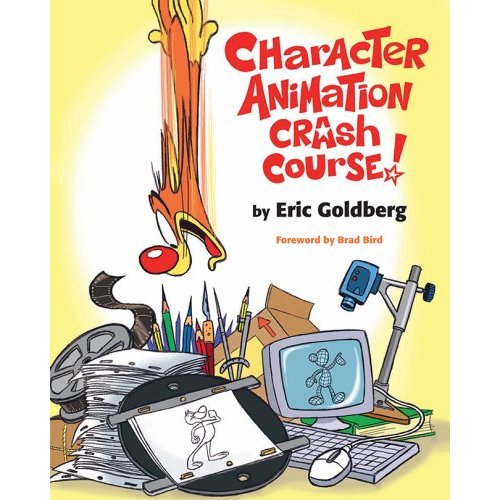
      5. Character Animation Crash Course. The Character Animation Crash Course by Eric Goldberg is an excellent resource by one of the most talented 2D animators in the world - the man behind the genie in Disney's Aladdin.
      6. The Complete Digital Animation Course. The Complete Digital animation Course by Andy Wyatt is a very useful overall guide to all the processes involved in digital animation and film-making. Especially good for the technical bits that the older books don't cover. 
      OK - what else? The next thing to do is get yourself a free copy of Maya, and open it up. Just to take a look! It looks a bit daunting at first but it's good to get familiar with the layout. You can register and get a free student license here.

      Once you have done that, take a look at the week 1 videos on my website Animation Apprentice. The week 1 videos are all free and this gives you a general introduction to the medium, helping you to get familiar with the language of animation.

      Other useful things you can do include going to life drawing classes, and filling a sketch book with sketches, doodles and ideas. Being able to express an idea in a simple sketch is still a useful skill, even in the digital age.


      If you do some or all the things on this list - you will have a great head start with us in September.

      ----Alex

      Friday, March 15, 2013

      Tom Sito's new book on the History of Computer Animation

      FLIP: Tom Sito's History of Computer Animation: Ivan Sutherland demonstrates Sketchpad, 1963. Being of a generation for which computers represented the future, it is a bit unset...

      Saturday, March 9, 2013

      Careful! You'll Hurt Disney's Feelings!

      Who knew?  The mighty multinational conglomerate that is Disney can't stand to be criticized.

      You are probably already aware that Disney has refused permission to use Disney artwork in Amid Amidi's biography of Ward Kimball.  Chronicle Books, the original publisher, has decided against publishing the book as a result.  Amidi is now making other arrangements for publication. (It appears that Amazon.com has de-listed the book or I would provide a link.)

      But it doesn't stop there.

      Don Rosa was a writer/artist of Disney comics whose work was hugely successful, especially in Europe.  He has written material in a nine volume collection of his work about the creation of his stories.  That is, until he got to the reasons why he retired.  Disney refused to allow that piece of writing to be published.  Perhaps because it highlights the medieval treatment of people who create Disney comics and how they are taken advantage of.  Perhaps because Disney's licensees exploited Rosa's name without compensation, so that he had to copyright his own name so that Disney licensees couldn't use it without his permission.  Rosa decided that he wasn't willing to be muzzled and put his explanation for retiring on the internet.

      In a recent podcast, author Sean Howe explained why his book Marvel Comics: The Untold Story contains no images from the comics.  This quote comes from 1:15:43 in the podcast.
      "I was going to license about 20 images and I got approvals for captions for those images and everything was typeset, the whole thing was laid out, and then I got the contracts. A price had been agreed on, but when I actually got the paperwork, I was going to have to agree that I would say nothing critical about Marvel Comics in the entire book.  A lot of people have asked me why there are no pictures from the comic books and that's the reason.  If I had used illustrations, I would have had to take out half of the book."
      Disney is so sensitive that it cannot tolerate anything that casts aspersions on its behaviour or the behaviour of its subsidiaries or licensees.  And look how absurdly ineffective they are at squelching it.  While they are busy attempting to suppress books, their behaviour is being noted all over the internet.  Amidi's book will eventually be published and I hope that Disney's refusal to grant permission to use images becomes a major talking point in the book's reviews.  Don Rosa's writing would have been limited to Europe, but is now readable by anyone in the world.  Sean Howe wrote the book he wanted to and has a tumblr where he has published more images from Marvel than he ever could have squeezed into his book.

      Disney's failure doesn't address the bigger issue.  From this point forward, any book on Disney, Pixar, Marvel, Star Wars or the Muppets that includes copyrighted images is tainted.  The author, rightly or not, will be suspected of compromising the text to satisfy Disney.  The books will be damaged goods.  The use of Disney-owned images will be proof that the book contains nothing critical of Disney.  So while Disney is trying to protect itself from criticism in print, it has essentially neutered any praise it may receive as it is biased.  Meanwhile, on the internet, Disney provides ammunition for those who want to criticize it.  Good thing nobody ever looks at the internet.

      Sunday, March 3, 2013

      John Carter and the Gods of Hollywood

      The perceived failure of Andrew Stanton's John Carter dominates any talk of the film itself.  I say "perceived" because the film was the victim of studio politics and ineptitude.  It was easier to bury studio mistakes and move on than it was for Disney to take responsibility for the debacle.  And while I am not a fan of Andrew Stanton's Wall-E, Stanton is, perhaps, the biggest victim of how the release of the film was handled.

      Michael D. Sellers has cataloged all the missteps in his book, John Carter and the Gods of Hollywood.  A fan of the work of Edgar Rice Burroughs, he covers the writing of the original novel, A Princess of Mars, and Burroughs interactions with Hollywood, predominantly on the Tarzan films.

      Animator Bob Clampett was the first one to attempt to turn the John Carter stories into film, albeit animated.  While Clampett produced samples, he was unable to find a backer for the series.  At various times, Ray Harryhausen, Disney, and Paramount were interested in the property, but while scripts were written, nothing was produced.

      Andrew Stanton first became a fan of John Carter though Marvel's comics adaptations.  When the rights became available, he was working on Wall-E and asked Dick Cook, Disney Studios chief, if could direct it as his next project.  Cook secured the rights.  As Stanton moved onto the project, two questionable decisions were made: setting the budget at $250 million and not casting stars.

      Shortly after the budget was set, Dick Cook was out at Disney.  It's common in Hollywood for projects to be orphaned when executives are fired.  In this case, given Stanton's importance, it was impossible to cancel the project, but Cook's replacement, Richard Ross, was not enthusiastic. 

      Neither was Robert Iger, who fired Cook.  Iger's pattern is to buy established franchises like Marvel and Lucasfilm rather than spend the money to develop franchises in-house.  In fact, at the time Cook was giving John Carter a green light, Iger was negotiating to buy Marvel, which would give Disney a line-up of characters all better known to the public than John Carter.  And while John Carter was in production, Iger was negotiating with George Lucas for the purchase of the Star Wars franchise, one that would give Disney a much higher profile space adventure than John Carter

      While the studio was willing to allocate a standard marketing budget for the film, it was not willing to spend more.  Given the risks associated with the production budget, this could be seen as prudent or foolish.  In addition, once Ross was in place, he hired a new director of marketing, MT Carney, who had no experience marketing films.  What made it worse is that she was fired before John Carter was released, so there was little continuity in the marketing campaign.

      Months went by without marketing activity for the film.  The release date was moved from summer to March, which raised questions as to whether the film was strong enough to compete with summer blockbusters.  "Of Mars" was dropped from the title, leaving the very generic sounding John Carter.   The budget began to attract attention, the implication being that costs were out of control. Stanton's interviews implied that he was less comfortable with live action production than animation, which didn't help the perception that the film was over-budget.  In reality he held to the budget, including 18 days of reshoots.

      For the March release, the film's main competition would be The Hunger Games.  Sellers shows how that film trounced John Carter in creating audience awareness prior to release. 

      The film did not open with enough box office to suggest it would be profitable, but only 10 days into the release, Disney publicly declared the film a failure and indicated that it would write off $200 million on it.  It's unusual for a studio to abandon a film while it is still in release domestically and yet to open all around the world.  Sellers explanation is that Richard Ross made the announcement early so that it would be old news by the time Iger next had to meet with the financial press for the quarterly earnings report.  It also attached the failure to Richard Ross, who Iger was about to replace. In total, the three executives most responsible for producing and marketing the film -- Dick Cook, MT Carney and Richard Ross -- were all fired.  Stanton was sent packing back to Pixar.

      Sellers is scrupulous about his statistics and quotes, but less scrupulous when it comes to his own involvement.  While he admits to being a Burroughs fan in the introduction, it isn't until the second half of the book that he reveals that he is the proprietor of www.thejohncarterfiles.com, a fan site that collected information about the film prior to its release.  He also cut a fan trailer that received a lot of praise for being better than the official trailers and he met with Disney, hoping to involve himself in the film's marketing but was rebuffed.  While there is no question about the facts surrounding John Carter, Sellers actions do raise questions about his motives for writing the book.  He is not a dispassionate reporter but a spurned fan.  Is the book reportage or revenge?

      Ultimately, John Carter fell victim to three problems: a budget that made it difficult for the film to be profitable; source material that seemed old hat after influencing other science fiction projects; and a major changing of the guard and focus at Disney's film studio.

      Andrew Stanton brought his first live action film in on budget, a major accomplishment considering the difficult logistics of the project, but the merits of the film couldn't overcome the aforesaid problems.  Sellers has written a textbook for all the things that can go wrong off a movie set that ultimately affect the success of a film.  John Carter isn't unique, just the latest Hollywood film to be mismanaged and cast aside.

      Friday, February 22, 2013

      Sick Little Monkeys

      The story of the making of Ren and Stimpy is one of an irresistible force meeting an immovable object.  The irresistible force was John Kricfalusi, a veteran animation artist who was disgusted with the quality of TV animation.  He was determined to push the art and humour closer to the Warner Bros. cartoons he admired, though with a decidedly personal twist.  The immovable object was the TV industry, specifically cable channel Nickelodeon.  Like all channels, it was dedicated to budget restraint, regular air dates, and bland content that wouldn't provoke attacks.  From the start, this relationship was a disaster in the making.  The surprise, though, is that it produced a hit show.

      Thad Komorowski's book, Sick Little Monkeys: The Unauthorized Ren and Stimpy Story, exhaustively examines the behind-the-scenes goings on.  He starts with John K's career in Saturday morning cartoon factories and details his relationship with Ralph Bakshi.  Together they made The New Adventures of Mighty Mouse, a sort of precursor to Ren and Stimpy.  Even before Ren and Stimpy, Kricfalusi was butting heads with broadcasters, as his experience on the short-lived Beany and Cecil revival shows.

      For those not familiar with the history of Ren and Stimpy, it was one of Nickelodon's first three original animated series and the one that attracted the most attention.  There was no question that John K's sensibility was a success with audiences.  However, right from the start, the show developed schedule problems due to a mismatch between what the artists wanted to make and what Nickelodeon was willing to air. John K. was another factor delaying production, as he wasn't willing to approve things until they met his standard.  When the delays continued during the second season, Nickelodeon fired John K. and his studio.  Nickelodon created its own in-house studio to continue production and Ren and Stimpy lasted for another three seasons without John K.

      While that might have been the end of the story, John K. was reunited with his characters when another cable channel, Spike TV, revived the series for an adult audience.  Unfortunately, Kricfalusi's insistence on meeting his vision at any cost doomed the revival.  While the order was for just six episodes, only two made their air dates and the last delivered a year late.  Spike lost interest in the show and didn't bother to play three of the episodes.

      John K. is a controversial figure who divides artists and fans into those who support him and those who think that he is responsible for his own misfortunes.  Komorowski walks the middle ground, showing that all parties made mistakes and refused to consider the others' point of view, but he does not excuse Kricfalusi's behavior.  Komorowski talked to many artists who worked on the show and quotes many Nickelodeon executives on the problems they faced getting episodes on air.  While I don't doubt that people involved in the production could quibble with Komorowski's version of specific events, it strikes me that the book is even-handed in apportioning credit and blame.

      Fans of the show will enjoy comparing their opinion of each episode to the author's and learning of material that was cut and censored.

      If you are not a fan of the show, this book is still worth reading for the light it sheds on the workings of the TV animation business.  There is always tension between artists and business people over resources and content.  People working in TV animation and those with ambitions to create shows need to understand the pressures and the pitfalls that shape the business.   Sick Little Monkeys: The Unauthorized Ren and Stimpy Story is a cautionary tale about walking the fine line between artistic ambition and the reality of the marketplace.

      Sunday, December 30, 2012

      Who's Afraid of Song of the South?

      Disney historian Jim Korkis's latest book is Who's Afraid of the Song of the South? and Other Forbidden Disney Stories.  The main section of the book is an in-depth look at the production of the film that Disney has chosen to suppress.

      While Korkis deals with the current controversy surrounding the film, he traces the film's origins and shows that the controversy started even before the film was released.  In the period after World War II, when the U.S. had defeated a fascist power that claimed it was racially superior, Black Americans felt strongly that it was time for the United States to abolish its own discriminatory practices.  That included the portrayal of Black people in popular culture.  Black audiences were no longer satisfied with stereotypical screen portrayals of porters, maids and lazy or frightened comedy relief.

      In the post-war years, Hollywood began to tackle discrimination in live action films such as Gentleman's Agreement (1947), which dealt with discrimination against Jews, and Pinky (1949), where a Black woman passes for White before returning to her own community.  But it wouldn't be until the 1950s and the rise of Sidney Poitier before Black performers were cast in leading roles that were dramatically respectable.

      Song of the South (1945) sits at the cusp between pre- and post-war racial attitudes and as Korkis shows, that's one of the things that makes the film hard to deal with.  The various screenwriters included a southerner with typical racial views as well as a left-leaning victim of the blacklist.  Black actor Clarence Muse was hired as a consultant, but left the project over the film's racial attitudes, yet Muse himself later appeared in films like Riding High (1950) and The Sun Shines Bright (1953), neither of which could be considered racially progressive.  The reviews of the time also straddle changing racial attitudes, with some wholly praising the film while others expressing reservations on its treatment of race.

      Korkis covers the writers, the cast, the production of the live action, the animation, the music, the reviews and the controversy surrounding the film.  Beyond the race issue, the film is important for other reasons.  It was Disney's first foray into a feature dominated by live action.  It was photographed by Gregg Toland, cinematographer of The Grapes of Wrath (1940) and Citizen Kane (1941), and this was Toland's first film in colour.  Bobby Driscoll and Luana Patten, the child stars in the film, went on to other star in other Disney films, making them the first live performers under contract to the studio.  It was also the first Disney live action film to receive an Oscar, albeit an honorary one for James Baskette, who played Uncle Remus.

      Korkis also writes about how the animated characters were used in other Disney projects such as Splash Mountain and various comics and other publications.

      The balance of the book is a bit of a hodge podge, lacking the strong focus of the first 100 pages.  Some of the material is related, such as the deleted Black centaurette in re-releases of Fantasia.  While the material covered is interesting, such as Disney's failed attempts to craft films based on the Oz books and John Carter of Mars before the films that were eventually released, this material could hardly be described as "forbidden."  Korkis is a thorough historian and the material is interesting, but as a book, it doesn't hang together as strongly as it might.

      Be that as it may, there's a wealth of interesting Disneyana here.  Korkis's dedication to shining light into the nooks and crannies of Disney history always produces surprises for the reader and fills out the picture of Walt Disney and the company he created.   As the current Disney management would prefer to forget the existence of Song of the South, this book serves as the closest the film is likely to get to a "making of" book.

      Friday, November 23, 2012

      Who Owns History? Who Owns Culture? Who Owns Speech?

      The Walt Disney company is responsible for delaying the publication of Full Steam Ahead!: The Life and Art of Ward Kimball by Amid Amidi.  The reason, according to the author, is that Disney is unhappy that Kimball's life doesn't conform to the company's exacting standards.  Disney has had the book since January of 2012 and has yet to approve it.  The publication of the book has been delayed a minimum of seven months, preventing those who pre-ordered the book from reading it and delaying earnings for both the author and publisher.

      I have not read the book and I certainly don't know the specific text that Disney is objecting to, but I find this situation to be very troubling for the chill it casts over our ability to comment on the world we live in.

      We are now in a time where entertainment corporations have run amuck.  I have recently written about Sony taking ownership of any artwork submitted by job applicants.  In Finland, the police have confiscated the laptop of a nine year old girl for downloading a single song from the Pirate Bay.  In addition, they have fined the girl 600 Euros, even though the girl's father has proved that the girl later bought the album and concert tickets for the band in question.  Several countries have instituted laws where three copyright violations can result in a user being banned from the internet altogether.

      One of the problems with this ban is how arbitrarily copyright violations are enforced.  All over the web, there are sites which could be construed to be violating copyright.  I say "could be" as a court could decide that material qualifies as fair use.  And the copyright holder gets to selectively decide who to prosecute and who to ignore.   In other words, if the company thinks the copyright violation is good marketing, it will turn a blind eye. 

      Beyond the logistics of corporations using the law to arbitrarily punish people, there is the much larger question of who owns history, culture and speech?  When culture is manufactured for a profit, do we have the right to discuss it, criticize it and respond to it?  Can we use examples to make our case or are we limited by the legal rights of the manufacturer?

      As the entertainment corporations are now multinational behemoths with whole staffs of lawyers charged with protecting intellectual property, they use the threat of legal action as a deterrent.  The Kimball book is a case in point.  In court, it could be argued that any Disney artwork used in the book is fair use.  What's one still image from the more than 100,000 frames in a feature film?  How is the publication of a still depriving Disney of income?  Disney could not suppress a book based on its text without proving libel, but it can suppress a book before the fact by denying the use of artwork and the threat of a lawsuit if a publisher decides to take a chance and publish anyway.

      Unfortunately, this is not an isolated incident.  Disney owns Marvel and denied Sean Howe, the author of Marvel Comics: The Untold Story, the use of illustrations unless they could approve the text of the book.  Howe and his publisher decided to forgo illustrations, so the history of a comic book company has no images of the artwork that made the company worth writing about.  And as I mentioned above, copyright prosecutions are arbitrary.  Howe has a tumblr where he has included images that should have been included in the book and so far, Disney hasn't complained.

      How strange is it that in the western world, it is permissible to comment on governments but not on companies that make cartoons?  As corporations have increasingly lobbied governments to write laws for their own benefit, we may soon reach a point where criticizing governments is irrelevant and the corporations who should be criticized will stifle all dissent.

      Sunday, November 4, 2012

      I Say, I Say...Son!

      While many gaps in animation history have been filled in the last 40 years, gaps remain.  That's why any new book that fills in some blanks is to be celebrated.  While Warner Bros. cartoons and certain of the directors have been covered relatively well, Bob McKimson has been present only intermittently in writings about the studio.  Part of the reason is that he died just as animation history was moving into high gear and partially because he never attracted the critical or fan attention that directors like Chuck Jones did.

      This book (with excerpts available at the link), written by McKimson's son, Robert Jr, also covers McKimson's brothers Tom and Chuck, both of whom also contributed to Warner Bros. cartoons in the areas of character design and animation respectively.

      While the book covers their entire careers, it doesn't go into as much depth as I would have liked.  Given that the author was a relative, I wish there had been more about the brothers as people.  I didn't get a good picture of their personalities or their relationship.

      As well, the book isn't specific enough about some of the work.  Chuck McKimson animated for Bob for several years in the post-war period, but no scenes are identified as his work and there is no discussion about how his animation differed, if at all, from his brother's.  While the author is right to point out that Bob McKimson was the only Warner Bros. director who continued to animate on his cartoons, with the exception of The Hole Idea (animated entirely by the director due to the studio shutting down temporarily), there are no animation scenes identified from his years as a director.

      There's also no discussion of the evolution of the McKimson brothers' art over time.  It's clear from the illustrations that their styles changed over the years, and not always for the better.  By the 1950's, there's a tightness to some of Bob McKimson's drawings that compare unfavourably to his work during the 1940s.  In the '50s, he had a tendency to draw arms and legs on characters like Bugs Bunny with parallel lines, causing the character to flatten out considerably.  The liveliness and energy that he gave to Bugs in earlier years seems to have dissipated.

      The best parts of the book are the illustrations, which cover a range of fields: animation, comics, colouring books and publicity artwork.  The McKimson brothers had a definite influence on the look of Warner Bros. cartoons, especially in the years before the end of World War II.  Bob and Tom were major contributors to the Bob Clampett unit and Bob McKimson was arguably the main artistic influence on the look of Bugs Bunny, first for Tex Avery and later for Clampett.  As a director, Bob McKimson is probably best known for Foghorn Leghorn and the Tasmanian Devil, who appeared in his cartoons exclusively.

      The McKimson brothers are certainly worthy of a book and this one is a start.  As it is the best currently available, it is worth having, but there's a lot more to be said about the brothers and I hope that this isn't the last we'll read of them.

      Monday, October 22, 2012

      Marvel Comics: The Untold Story

      Sean Howe's book Marvel Comics: The Untold Story could just as easily have been subtitled The Never Ending Story.  It's never ending as Marvel's fictional characters die, are brought back, change their powers, get replaced, get cloned, make deals with the devil, but still go on and on.  It's also never ending because the creators behind these characters leave in disgust, get fired, sue the company and sometimes die on the job.

      This book is a warts-and-all telling of the people and business behind the creation of the Marvel universe, known for characters such as Spider-man, the Fantastic Four, Captain America, Iron Man, Thor, the Hulk and the X-Men.  While it is only tangentially related to animation, it shares the problems of work-for-hire and the callous way that corporations treat the very people who create the wealth.

      For those who haven't followed the comics or the company, this book may be a maddening read, as the cast of fictional and real characters runs into the hundreds.  The size of the cast prevents Howe from going into depth on more than a few people, mainly the owners, editors and to a lesser extent, writers.  The artists, as usual, get short shrift.  Anyone interested in learning more about artists John Buscema, Gene Colan and similar mainstays of the company will be disappointed.  The artists are mostly bystanders while the dance of power and money goes on above their heads.

      Martin Goodman was a publisher of pulp magazines, a now extinct breed of publications that focused on genre fiction with detectives, cowboys, aviators and similar action-oriented characters.  They were named pulps for the cheap wood pulp paper they were printed on.  After the success of Superman in Action Comics in the late 1930s, Goodman was convinced to add comic books to his list of publications.  Within the first few years, he published The Human Torch (created by Carl Burgos), The Sub-Mariner (created by Bill Everett) and Captain America (created by Joe Simon and Jack Kirby).  He hired his wife's cousin, 17 year old Stanley Leiber to work in the comics division and in 1941 when editor Joe Simon left (with Kirby) after Goodman screwed them out of Captain America royalties, Leiber writing under the pseudonym Stan Lee inherited the post of comics editor.

      With the exception of his stint in the military during World War II, Lee continued running the division and created nothing of value until 1961.  At that point, partnered with Jack Kirby and Steve Ditko, newly successful characters appeared for about a decade.  However, both Ditko and Kirby walked away from Lee and Marvel, angry over their lack of control and compensation.  Once that happened, Lee spent the next 40 years promoting Marvel and himself but failed to create anything similarly successful.  His greatest accomplishment was keeping himself front and center as the ownership changed repeatedly, garnering millions for himself while not lifting a finger as President and Publisher of Marvel to compensate the artists beyond paying them by the page.  He even colluded with his competitor, DC Comics, to make sure that freelancers couldn't play the two companies off each other for higher pay.

      It's fitting that Disney now owns Marvel as the companies have similarities in their histories.  The business people who have taken over both companies after their founders have earned far more than the creative people who built the company in the first place.  Eric Ellenbogan, a Marvel executive who lasted just seven months, walked away with a $2.5 million severance package, more money than Jack Kirby made from Marvel in his entire career.  That's hardly different than the $140 million in severance that Michael Ovitz walked away from Disney with, more money than all nine old men made over 40 years.  John Lasseter is rapidly becoming another Stan Lee, agreeing to corporate moves he formerly disdained (like sequels) and becoming a kibitzer of other people's work rather than remaining a creator himself.  For both companies, the '90s were an anomaly where artists actually shared in the money their work generated.  Marvel went bankrupt and Disney abandoned drawn animation and the artists who created it.  In both cases, the good times didn't last.

      The book contains just two illustrations: an ad for the first issue of Marvel Comics and a photograph of Stan Lee and Jack Kirby in 1965.  Undoubtedly, the publisher didn't want to deal with Disney's well-known reluctance to grant the rights to images it owns (see the delay in Amid Amidi's biography of Ward Kimball).  However, Howe has a tumblr blog which includes many illustrations and documents that should have appeared.  Somehow print attracts the copyright cops while the web escapes unscathed, more proof that the copyright laws are dysfunctional in the digital age.

      Anyone who aspires to work for a leading comics or animation company and thinks they'll be entering a magic kingdom where creativity reigns supreme and the fun never stops should read this book.  Large media corporations share many of Marvel's problems. Artists are routinely taken advantage of, and the more artists realize this on the way in, the less likely they are to be disappointed.