Showing posts with label Meet our tutors. Show all posts

Monday, October 27, 2014

Meet Our Tutors - Sabah Masood

Exterior shot by Sabah Masood
Sabah Masood is one of our newest tutors at Bucks, having just started teaching our students pre-production concept art and development. Sabah has a wealth of freelance experience designing, building and lighting 3D interiors and sets for clients such as Pinewood Studios. Her expertise helps to fill out some gaps in our existing curriculum, making sure that our students are fully prepared for a long and successful career in the digital arts. We asked her to talk about what she is teaching at Bucks, and how the experience has been so far.

Interior by Sabah Masood

Bucks: What are you Teaching at Bucks?

SM: At the moment I am teaching pre-production concept art which the the students will carry out for all their major projects at university. This will allow them to be more creative and imaginative when creating their final designs in 3d software. Having a pre-concept is vital in any production as this is the foundation to creating a finalized render.


Bucks: How has the experience been?

SM: I have always loved helping people so having this opportunity to teach an entire class (instead of just helping students individually) is on a whole new level. At first I was unsure of how the class might perceive my teaching skills, but my feedback has been positive and I am loving every moment. Teaching something you personally have a passion for makes the role more interesting and so the flow of words comes more naturally.

 
Gateway Building at Bucks

Bucks: How have you been able to bring your own experience as a freelancer to assist in the classroom?

SM: Most of my projects are all freelance as I feel this way I can express my work the best for I have no limits but more freedom to experiment.  By working on freelance projects I have been able to identify the difference between working on a personal projects where this usually no boundary of imagination and working on a client projects which requires more of a *realistic* approach. either way, my skills and passion have increased incredibly and now I feel more confident in expressing these views and forwarding these skills onto my students.

I learn new skills on each freelance project I work on so the *rights and wrongs*  must be taken into action in according to what the client is requiring. when teaching i will mention how freelance work must be carried out in the right way and how they should go abouts freelance in terms of finding, selling and idea and the actual post production process.

Centroid Academy by Sabah Masood

Bucks: What advice would  give our students who would like to forge a career in animation and VFX?

SM: The most important statement I wish to make is this: you must have the passion for what you do! If the passion and ambition is there, the work process will not come of a pain to you but you will enjoy it! My 3d work only used to be in the classroom but when I found what i do best, i started working on personal projects at home. this increased my passion and skills incredibly. Even my free time is creating arch viz renders instead of going out.

The more you practice and work on personal projects (other than university projects), the more your skills will improve as well as your ambition which will help you later on in finding a job int the animation industry. From my personal experience, the industry directors and producers are not looking for people with the highest degree result but for people who have the passion for what they do and their skills they personally have.

Secondly I recommend advertising your work. By advertising I mean creating a personal domain website which included your portfolio. Create a business card and maybe even an 15 flyer which you can hand out. Attend conventions in London such as Eurogamer or Bluegfx where you can create contacts and meet industry people.  The more contacts you have, the better!


To see more of Sabah's work, see this blog post. And to see more about the tutors at Bucks and what they do, follow this link.

Thursday, October 23, 2014

Bucks Tutor Rob Kelly Talks About His Work On BBC 2 Idents


BBC ident by Rob Kelly
Rob Kelly is a director with a long track record in the TV industry, and of course he is one of the tutors on the Animation and Visual Effects course at Bucks. Rob lectures in motion graphics, primarily using AfterEffects to teach our animation students (amongst others) to create excellent motion graphics work. In this interview at the Film and TV blog at Bucks, Rob talks about his work directing some of the classic BBC 2 Idents, and how he created them.

Saturday, August 16, 2014

Bucks lecturer Alex Williams talks about his work on the Harry Potter films


Bucks lecturer Alex Williams worked on the last three Harry Potter films, while employed at the London VFX house Cinesite, in London's Soho. We asked him to talk about what he did on this very popular films series which help to transform the scale and quality of visual effects work being done here in the UK.


Bucks: What did you do on Harry Potter?

Alex: I worked on the last three installments of the Harry Potter series. On Harry Potter and the Half-Blood Prince, I helped to animate some magical birds which Hermione creates when she is angry with Ron Weasely. The work was done at Cinesite in London, and I was one of two animators who did the animation.


The birds were modelled and rigged extremely carefully, with a full range of motion such as folding wings, and individual feathers, to withstand very careful scrutiny. This is often the case on a visual effects job, where you have to create assets that are suitable for an extreme close-up - even though you might only end up using them in wide shot. When you go and see the final version in the movie theatre you think: "why did we do all that work? It goes by in an instant and it's all motion blurred!" But that's the VFX business - you never know when the client will ask for something new and complex - and you have to be prepared for every eventuality.


Bucks: What else did you work on?

Alex: I also did some design work for the Patronus Doe in the last two installments of the series: Harry Potter and the Deathly Hallows, Parts 1 and 2.  The modeling department at Cinesite had created the 3D models, but the client was not happy because they weren't appealing enough. Needless to say, the models were in fact very accurate, based closely on the topology of real deer which they had used for reference. But often what is needed when you model something realistic is a kind of heightened reality, not actual reality. Movies are an illusion, after all, and visual effects are just that - an effect. So my job was to make the doe seem cuter, more appealing, more like Bambi than a BBC nature documentary.


My background in animation was as a 2D animator, and I have always loved to draw. So the job was a pleasure for me, as it utilised all the skills I had learned on traditionally animated movies like The Lion King and Spirit - Stallion of the Cimmarron.  The client was very happy with the revised designs (which were still realistic, just more appealing) so we went ahead and made the changes to the 3D model. Below is a clip of what the Patronus looked like once it was animated.


Bucks: What was it like working on Harry Potter?

Alex: It was a real privilege to work on a film series that was seen by so many people and did so much for the London visual effects scene. Also, on a personal level, it's nice to work on something that people have actually heard of!

For more on the experience of studying at Bucks New University, come and visit us at one of our Open Days,  take a virtual tour of one of our animation studios, check out what our students think of our course, and see why we're ranked in the top 12 creative universities in the UK. Find out why we're giving free laptops to all our students, and why we give all our students free access to videos at Lynda.com. Also, see what financial assistance might be available to you. Learn which is better for animation, a PC or a Mac? Get hold of a copy of a map so you can find your way around campus, and learn about motion capture at Bucks. And find out about how our online video tutorials work.


Friday, July 25, 2014

Bucks Lecturer Allen Stroud introduces Lave Revolution

Lave Revolution by Allen Stroud
Bucks lecturer Allen Stroud is a man of many talents. Among his many duties at Bucks, he teaches our first year animators Flash, the 2D animation software that can be used to create excellent animated films. He also has a number of media projects in development, including Lave Revolution, based on the pioneering early 1980s video game. We asked Allen to talk about his work inside and out of the university.


Film and TV students at Bucks
Bucks: You run the Film & TV course at Bucks – what does that involve?

Allen: We've been a full degree programme since 2008. My role in that is to organise course-related things. So, induction week, module options and stuff that is about the overview of the programme. I also run the course team meetings and am the student's port of call for assignment extension requests. I'm sure there's a few more things on top of that - as it all keeps me busy.

Adobe Flash
Bucks: You also teach Flash to the animation students at Bucks – what is it about Flash that makes it good for animation?

For me, Flash has been more of a design tool than an animation device, but the way in which it emulates a video editor whilst giving you tools that animators need to create their images is a nice touch. The incorporation with more advanced graphic packages, like Adobe Photoshop and more advanced animation suites, like Toon Boom Studio make it a good starting point. The pen and pencil tools also make my rubbish drawings look vaguely recogniseable too!
 
Allen Stroud

Bucks: What projects outside Bucks are you working on?

Allen: I'm a writer and academic researcher. Currently I'm working on a PhD that covers the design of fantasy and science fiction worlds.


I also worked on the forthcoming Elite: Dangerous (http://elite.frontier.co.uk) as a concept writer and the official novelist. The project is based on the early 1980s video game Elite that was made for the 32k BBC computer. It was a classic of its time, and it's very exciting to be helping to revive it. We managed to raise the budget needed to get it started on Kickstarter - which was a great experience. Crowd funding is a very promising way to get new projects off the ground.

Elite Dangerous - production artwork
Right now I am working on Chaos Reborn (http://www.chaos-reborn.com) as the fiction world designer and, again, as the official novelist.

Chaos Reborn

I also review science fiction books for Sfbook.com - (http://sfbook.com/journal-of-the-plague-year.htm) and I am running a variety of different workshops for conventions over the summer whilst working on further novels.

Elite Dangerous - production artwork
Bucks: How can animators get more involved in other areas of film production at Uni?

Allen: Like most things, there is a need for individuals on both courses to see the advantage working together will bring. We have a wide variety of films being produced by our students, with many animation and VFX outputs.

To get in on the Level 6 films, animators need to demonstrate how they can add something to the ideas the Film maker may have. That means getting involved at the planning stage and having some work to show. Ultimately, working relationships among the students come down to trust, quality and reliability. You don't work with people who let you down or do a bad job.

Gateway Building - our media hub at Bucks
Bucks: What are you most proud of here at Bucks?

Allen: I think I am most proud of the fact that Film and TV has proved to be a successful course, and also of course I am proud of the work our students produce. I am continually amazed at the ways in which they are able to create and innovate from the ideas we give them in class. It really is fantastic to see.


Allen Stroud, Course Leader for Film and Television Production, is donating ten per cent of the proceeds from his new sci-fi ebook Elite: Lave Revolution to the charity Ehlers-Danlos Support UK. Allen said: “The book is written under official licence from the creators of, and based in the vast universe of, the space trading computer game Elite: Dangerous. I am hoping to raise as much possible for charity through sales.” Find out more about the book and how to buy it at the Fantastic Books Publishing website. Allen is also co-delivering a presentation with well-known BBC technology reporter Kate Russell at the science fiction and fantasy Nine Worlds Convention in London on Friday 8 August on ‘How to get an idea crowdfunded’.


To see the impressive work done by our students and recent graduates here at Bucks, check out SuperFergy in 3D by Anton Alfy, see the work of Jens Kopke,  Ben Gray's Moonbeam, and the architectural visualisations of Sabah Masood and Anton Alfimenko. Also take a look at the work of Andy Thomas here, see our latest commercial project for Rocketseed, our short film done for a global aid agency, and take a look at the excellent work of designer Monika Dzikowicz, architectural visualisation specialist Krsytof Michalski, Alex Whitfield and the 3D artwork of Mike Swan. And don't forget to see the simulation work of our students done in RealFlow. To see our student demo reel, click here.


Thursday, July 24, 2014

Bucks lecturer Alex Williams introduces "Queen's Counsel", and a new book of cartoons

The Queen's Counsel Lawyer's Omnibus - 20 years in The Times
Bucks animation lecturer Alex Williams initially trained as a barrister, and since 1993 he has published a weekly cartoon strip Queen's Counsel in the law pages of The Times. Recently he published a new book, The Queen's Counsel Lawyer's Omnibus, a compilation of his favourite cartoons printed in the newspaper over the past 20 years. We asked him to talk a little about the book, and also about how a lawyer became a cartoonist and an animator.
Alex Williams

Bucks: You were a barrister before you became an animator? How did that happen?

Alex: Well, I had done a fair bit of animation before I became a barrister, but yes, in 1992 I went to law school and trained for the Bar. I became a junior barrister in 1994, and it was a year before that (in 1993) that I and a friend approached The Times and The Spectator with the idea for a comic strip about lawyers. It was the era of lawyer jokes and the OJ Simpson trial, so we got lucky with the zeitgeist. The Times said yes, as did The Spectator.


Bucks: Why this new book now?

Alex: The new book is a celebration of twenty years at The Times. The strip has been published in the newspaper every week since 1993, making it the longest job I have ever held down, by far. It's a compilation of the best jokes over the years. Or, at least, the ones I think are the best.


Bucks: What are the cartoons about?

Alex: The cartoon strip is a satire on law and lawyers. I started the strip as a way of poking fun at the legal system, my fellow law students (and lecturers) and - later - my colleagues at the Bar. In the early years the strip was really about my own life as a junior barrister. I would go to court, something bizarre would happen, and I would think: "how do I turn that into a four panel gag?".


Bucks: You're not a lawyer anymore - where does your material come from?

Alex: Even after 20 years I continue to love writing and drawing Queen's Counsel. Actually I feel as though I am just getting into my stride. If it takes 10,000 hours to get good at something, I guess I'm  probably just about starting to have done my time after two decades.

Also, my wife Sarah is a solicitor, so she keeps me up to date. She'll come home after a gruelling day of corporate litigation, and she'll be telling me about her day - and I grab a pencil and start writing it down. So she really writes my jokes these days - or at least the funny ones.

Bucks: Which are your favourite gags?

Alex: It is hard to pick out my favourite comic strips but some of the early jokes which were most autobiographical are probably still my favourites. It reminds me of what I was going through at the time, almost like a personal diary in cartoon form.


Bucks: What has all this got to do with animation and visual effects at Bucks?

Alex: Well, you'd be surprised. Cartoons and animation are close cousins; it's all about characters, and it's about telling a story. The audience have to like the characters, even if they're not very nice (most of mine are not). It's the same with animation and film-making; it's all about telling a great story. The Animation and Visual Effects degree is heavily focused on practical skills to equip our students for a freelance career. We want our students to be great story-tellers and great technicians.


Bucks: What about your students - will they do cartoon strips and books?

Alex: I certainly hope so. I hope that many of our students will go on to publish books of their own - perhaps collections of their own work, perhaps books on animation, or even books on ground-breaking new visual effects technologies. Being able to put a pitch together and approach a publisher - or even self-publish - is part of the essential toolkit of an independent freelance artist. Our students will go on to enjoy careers in many different parts of creative and digital media and we want our course to be a superb preparation for their journey.


Bucks: Where can we buy the book?

Alex: It's at amazon, naturally, and you can also buy it direct from Law Brief Publishing at www.lawbriefpublishing.com. Bring a copy in to Uni and I'll sign it for you!


To see the impressive work done by our students and recent graduates here at Bucks, check out SuperFergy in 3D by Anton Alfy, see the work of Jens Kopke,  Ben Gray's Moonbeam, and the architectural visualisations of Sabah Masood and Anton Alfimenko. Also take a look at the work of Andy Thomas here, see our latest commercial project for Rocketseed, our short film done for a global aid agency, and take a look at the excellent work of designer Monika Dzikowicz, architectural visualisation specialist Krsytof Michalski, Alex Whitfield and the 3D artwork of Mike Swan. And don't forget to see the simulation work of our students done in RealFlow. To see our student demo reel, click here.


Thursday, July 17, 2014

Meet our tutors - Alex Williams

Alex Williams
Alex Williams has been teaching at Bucks since September 2012 when he first joined the animation team. Alex has spent 25 years working in the animation industry, and his arrival at Bucks has led to an increased emphasis on the art and craft of animation at Bucks - hence the change of title of the course from "Animation, Games and Interactive Media" to "Animation and Visual Effects". We asked Alex to talk about the changes going on at Bucks, and what students can look forward to.

Bucks: What did you do before coming to Bucks?

Alex: I spent twenty five years working on animated films, from "Who Framed Roger Rabbit?" to "The Lion King", The Iron Giant", and the last three Harry Potter films.
Design for Patronus Doe, Harry Potter and the Deathly Hallows

Bucks: What made you want to go into teaching?

Alex: I have been teaching animation part-time since 1996 when I first started to teach at CalArts in Los Angeles. Later I taught at Gnomon in Hollywood, The Animation Workshop in Denmark, and Escape Studios in London. I was always doing my teaching around the edges of my work on production, in fits and starts, so I wanted to see what I could do if I really committed to it full time.

I love to teach and I want to make our new course a centre for animation excellence in the UK, so that our graduates have the best possible training, and can go out and have employers competing to hire our best students. That's a big ambition, but I think we can do it if we really focus on the important things.


Bucks: Why come to Bucks?

Alex: Bucks offered the chance to set up a new animation course from scratch, and run it. Such opportunities don't come along that often in life. Of course, there has been animation at Bucks for some time, so I share the leadership of the new course with Dave Creighton, who has been at Bcuks for many years, and between the two of us we designed the new Animation & VFX Course. Our new course incorporates many elements of the old AGIM course, but now there is much more of a focus on character and creature animation.


Bucks: What's new about the new course?

It is much more focused on animation. The animation and visual effects industry in the UK has been complaining for years that there are too few schools in Britain which offer a really thorough animation training on the level of, say, CalArts in LA or Gobbelins in France. I wanted to see if we could do something at Bucks that would aim really high, and train our animators to be ready to work in the animation industry from the day they graduate.

That's why we brought in Kevin Spruce, head of animation at Framestore, to be the external validator of our course. Kevin took a close look at what we are doing, and helpfully supplied us with a lot of material that Frame store use in-house to train their own animators.

Animation Apprentice: www.animationapprentice.org

Bucks: What about your online course? How does that fit in?

Alex: In September 2012 I launched Animation Apprentice, an online school which teaches animation to students all over the world. It is a distillation of everything I have learned on production and in the classroom over the years. It's a 30 week course which aims to teach animation from the very basics all the way to sophisticated character and creature animation.


Bucks: Will the students at Bucks have access to the same materials?

Alex: Absolutely. All my digital content has been licensed to the university for use in the new Animation and VFX Course. The beauty of learning online is this: if you miss a class, or didn't understand something, you get to go to the online videos and catch up. It means that no student should ever fall behind, as long as they put in the hours.


What can we look forward to?

Alex: As the course unfolds, I think we are going to see students doing really strong personal projects, making films, and winning prizes. One of our first students, Anton Alfimenko, has already won a prize for a short film he did about Sir Alex Ferguson, former chairman of Manchester United. Anton is passionate about football; it is my job as a tutor to find what students are passionate about and support them with that, so that they do work that they love and are proud of.


You can see Alex's film credits at the IMDB here, and also see his Wikipedia page here. You can also see an interview with Alex at Skwigly Magazine here, and a Skype interview with BabyBarista author Tim Kevan here. To find out about the other animation and visual effects tutors at Bucks, see more about Rob Kelly, who teaches Broadcast Graphics, and co-course leader David Creighton, who teaches a broad range of VFX skills.


Thursday, October 24, 2013

Meet our Tutors - Rob Kelly

Rob Kelly teaches Camera, TV production, Design and Motion Graphics at Bucks
Rob Kelly is a vastly experienced commercials director with a long and varied career in advertising and branding, and has numerous awards to his name. He has also worked as a creative director and graphic designer for some of the top branding, advertising and design agencies in London. We asked him to tell us about his remarkable career - and what brought him to teach here at Bucks New University.

Bucks: How did you come to be teaching here at Bucks New University?

Rob: A few years ago one of my kids’ teachers ‘volunteered’ me go into their school to teach Photoshop (I am a TV graphic designer/creative director as well as a TV commercials director). I realised instantly the buzz I get from teaching: watching the pennies drop as my students realise what they are capable of achieving.

BBC 2 Ident directed by Rob Kelly
I later went to Middlesex University to study for a PGCE teaching qualification but realised straight away that secondary schools were not the environment that I could best flourish in. It was obvious to me that higher education was the most appropriate environment for me to teach in given my professional background.

I got my teaching qualification and started looking for a university that teaches the subjects I specialise in: film, TV, design, animation, motion graphics and visual effects. It took a whole year to find the right job that I felt completely comfortable with but I am very happy that I waited for this position at Bucks.
Some career highlights
Bucks: What is your area of expertise and what are the projects you have worked on that you are most proud of?

Rob: I started off as a TV graphic designer at the BBC Open University before progressing to a company called Lambie-Nairn, one of the top branding and design agencies in the UK where I won many national and international design awards. Lambie-Nairn was the design group that created the original Channel 4 and BBC2 TV idents. My areas of expertise include TV graphic design, animation, motion graphics, green screen compositing, computer generated imagery, visual effects, special effects, live action direction, commercials direction and creative problem-solving.

Bucks: Which projects stand out the most?

Rob: Of the many projects I’ve worked on three really stand out. The first one was the very first TV title sequence I was ever asked to design at the BBC. The sequence went on to win a prestigious Design and Art Direction (D&AD) silver award for ‘outstanding educational graphic design.’ As I remember it only cost £100 to make but it kick-started my whole career!

BBC 2 Ident by Rob Kelly
The second project I am most proud of was a title sequence I designed for the Beatles Anthology, a TV history of the Beatles. You need to understand that I am the world’s biggest Beatles fan (I once never listened to any other band for three years! Seriously.) I got to meet a lot of the key people at Apple records, who I’d read about, and eventually got to work with Paul McCartney himself, who’s actually a really decent cove. We got on very well and we worked together on several more of his projects, but I was never allowed to ask for an autograph or have my photograph taken with him!

My favourite quote from my time working on the anthology was Apple’s MD telling me he was going to fax my initial storyboard to Paul and Yoko for their approval. I nearly fainted. He also once asked me to pitch on the design of the Beatles Anthology record covers, casually dropping in the fact that the other people I was pitching against were David Hockney, Klaus Voorman (designed the cover of Revolver) and Sir Peter Blake (designed the cover of Sgt. Pepper). Needless to say I didn’t win the pitch!

The third was a project I worked on last year for Watford Football Club. Bucks decided to embark on a very ambitious TV test project called The Hornets Show. This was to be a huge collaboration between animation students, film/TV students and audio students together with external clients from Watford FC, a professional TV presenter and Adam Leventhal, a specialist sports presenter/consultant from Sky Sports.

Each month the students create a 30 minute football magazine programme in a green screen studio composited into a beautiful CGI set that the 3D animation students designed. It was a very ambitious project but it was well worth all the effort because the students learned a huge amount, they really enjoyed working on it and the results looked fantastic, even if I say so myself. It’s probably true to say that no other university animation/film/TV course can offer such an ambitious and complex project which the students can use on their showreels to try to find work when they graduate. But it very nearly killed me though!
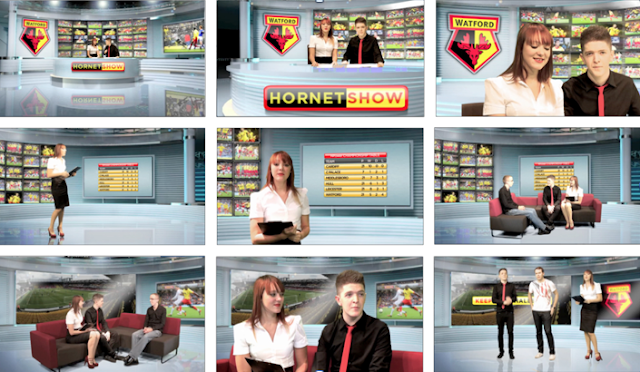
The Hornet Show


Bucks: What do you like most about teaching?

Rob: The best thing about teaching is the students. University students are here studying their specialised subjects, because they want to be here. What they learn here is what they will mostly be doing for the rest of their professional working lives. This makes it fundamentally different from teaching in a secondary school, where students are required to study subjects that they may well not be interested in. I love the way students grow more confident and self-assured and mature over the three years to become masters of their craft.

I still enjoy watching the pennies drop inside students’ heads when they realise how to achieve fantastic results after being taught some new technical skill. It sounds like a cliché but it’s endlessly rewarding.

I also love the many ‘Mr Chips’ moments that I have had the good fortune to experience since I have been here. For example, last year a second year student showed me a film he had made for a client which was so beautiful that it made me cry, right there in front of the whole class! Not something I would ordinarily do lightly. The students clearly understood why though!


Bucks: What are the biggest challenges for the students at Bucks?

Rob: Clearly the financial impact of the recent government changes to student fees have made a big difference to the student experience. However, interest in our courses seems to be higher now than before the increase in student fees. Students still clearly value a high quality university education as preparation for a profitable career. Many students have to balance part-time paid work with their university work in order to make money to live on. This doesn’t usually interfere with their studies but tutors are usually aware if there are any problems on the horizon and can offer pastoral care and advice to help their students.


Bucks: What advice would you give to any students considering applying to Bucks?

Rob: You should consider the results of the teaching at Bucks: look at recent graduates’ showreels (their animation/ film/TV projects). Is this the level of quality that you aspire to? At Open Days, talk to the lecturers who will be teaching you: decide if you’d like to be taught by them. Fully understand the course you’ll be studying and compare it to what you imagine you want to do. Consider the environment you’ll be working in, such as the Gateway, which is an incredible environment to teach and learn in.


The Gateway Building - our main media hub
On open days talk to the student ambassadors to see how they themselves feel about studying at Bucks. Walk around High Wycombe and see if it’s a place you’d like to spend three years. Go and see the halls of residence: decide if this is an environment you’d enjoy living in for your first year. Go and see other universities teaching the same subjects so that you can compare and contrast universities: make an informed decision where you’d like to study for three years. Consider whether you’d feel happy in all of these contexts as this is a big decision to make.

High Street in High Wycombe

Bucks: How can our existing students get the most out of their course?

Rob: When you arrive at any university in your first year it is essential to use your freshers’ (first) week to make as many friends as you possibly can. Stay in the halls of residence if you can, visit the students’ union, socialise, join as many clubs as you can, even join clubs that you’re not really interested in! Just make as many friends as you can. This first week at uni could shape your student experience and happiness for the next three years. The friends you make in your first week at uni could possibly be some of the friends you have for the rest of your life. I made the mistake of staying in my room feeling homesick the first two weeks when I first went to uni and had the most miserable and unhappy year.

On a more serious note when you work in any creative industry, whether it be animation, design, TV, photography, whatever, it is important to realise that in order to really excel in your field the real drive must come from within you. A university can teach you amazing things but if you don’t have the drive to push yourself to your limits you can’t achieve real excellence. Anyone can be taught to use animation software or a camera but you need to find it from within yourself to reach the heights of a John Lasseter, a Brad Bird, a Jon Favreau, a Paul Greengrass or a Ridley Scott.

The philosophy of Bucks university is quite simple: employability. Our animation and TV courses are designed to instil a sense of real professionalism in order that our students can find employment and forge a high quality career for themselves. Even though I’ve been working in the creative industries in many capacities for 30 years I still have to give 110% on every project I work on. If I don’t then I know my competitors certainly will. I must be doing something right - as I’m still working!

Title Sequence: Arabian Gulf Cup
Rob Kelly runs lectures and workshops on advanced camera skills, TV production, After Effects, Final Cut Pro and Photoshop to undergraduate students at all levels at Bucks New University. To see more of Rob's work, check out his excellent demo reel at pbshowfolio.com.

Thursday, October 17, 2013

Meet our tutors - Dave Creighton

Dave Creighton  by Monika Dzikowicz
David Creighton is one of the two Course Leaders on the Animation & VFX Course, and has long been the mainstay of digital media at Bucks New University. A 20 year veteran of teaching in High Wycombe, Dave has done and seen it all.

He can help with pretty much anything to do with animation and visual effects at Bucks; with two decades of experience he knows how the University works (or sometimes doesn't). We asked him to tell us about his work, and what students on the new Animation & VFX course can look forward to.

Bucks: What do you teach and what are your areas of expertise?

Dave: Over the years I’ve become something of a generalist teaching most areas of the 3D pipeline through modeling, texturing, lighting, rigging and animation. I’ve also taught compositing and motion graphics. I never really consider myself an expert in any one field. I guess the more you learn, the more you realise how much these areas of technology are evolving.

I’m a competent modeler and I enjoy the process of lighting and developing an eye-catching image. In the past, I’ve taught on art and design courses, trying to find innovative ways to enhance the creative/design process. Both Nick (Brown) and I have developed an eye for design, detail and proportion and this is really useful when working on projects like architectural visualisation, games environments and animation sets.
 
Helena Bonham-Carter - a visitor to Bucks. Photo: Wikipedia

Bucks: What are the highlights of your career at Bucks?

Dave: A long time ago I made furniture and made some interesting chairs for Phil Collins, Jeremy Paxman and Helena Bonham Carter. Jeremy and Helena came to the University to see the pieces, which was a fascinating opportunity to see their off-screen personas. I worked on a moving image piece with a textile artist, Polly Binns.

The piece was based on a photographic journey through the Norfolk Broads. The images had a strong diagonal theme and the final piece was shown in a gallery in Poole which itself had the same diagonal theme and had been inspired by Polly’s work.

The real highlight though has to be seeing the students that you’ve taught and got to know over three years, graduate with a sense of passion and confidence, finding their their place in the industry.


Bucks: What about teaching do you particularly enjoy?

Dave: Two outstanding things I enjoy about teaching are the students and the colleagues I work with. The students have an energy that is infectious and this keeps you passionate about your subject. Perhaps it’s the nature of the job, but I find most of my colleagues are humble, helpful and outgoing. I noticed this as soon as I started working at Bucks.

I also love learning and sharing what I’ve learnt, so in a sense, I still feel like a student myself! This is particularly true in our subject area as the technology moves on so fast.  You never stop learning.


Bucks: Our course is going through some big changes – what can the students look forward to in future?


Dave: Animation at Bucks has moved through various schools and departments over the years and has finally ended up in the department of Media Production. This has been such a positive move and the support we’ve received has been amazing! The Animation & VFX course is the culmination of lots of input from professionals like Alex and is now really well focused.

The support we get from the University in terms of equipment, software, studio facilities, motion capture and industry involvement is looking really promising. Being in this department also allows us to work with film and audio students, the virtual studio we produced for the Watford football club being a good example.
Watford FC's virtual studio was produced by Bucks students
At the start of term we had an industry panel as part of the Fresher’s week, and the range of high profile industry speakers who shared our passion was really inspiring. We’re really excited to see what our first intake on this new course can do in such an exciting environment.


Bucks: What advice would you give to a student who is struggling for any reason?

Dave: This is an easy one! Come and talk to us! It is not uncommon for students to get out of step with a course. It may be because of financial pressure, family commitments, too much socialising, or just feeling out of their depth.
E402. Dave's very scruffy office. Come and help him tidy up
Quite often a student will feel embarrassed that they are falling behind and not want to be shown up in class, so they stay home - and this just compounds the problem. By talking to their subject or personal tutor, or any tutor on the team that they are comfortable talking to, we can find out what the underlying problem is and develop a plan to get things back on track.

Some students worry that we may get angry or shout at them, but on the contrary, we just want to help! If a problem is more serious or the student is feeling quite low, we have an excellent counseling service which are very supportive and work closely with the course team.